
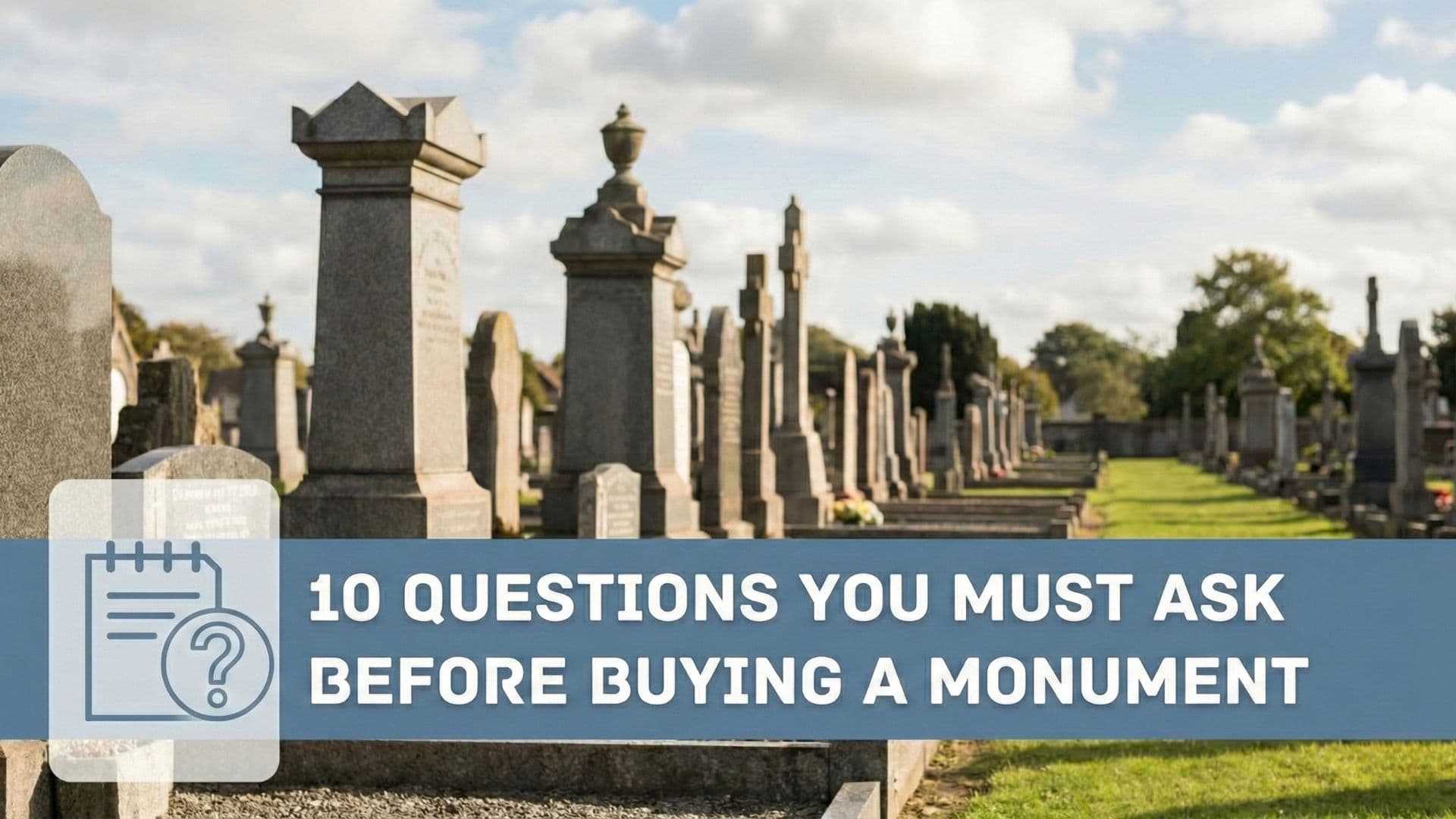
10 Questions You Must Ask Before Buying a Monument
A calm, practical checklist for families in Hudson and Northeast Ohio—written to help you avoid surprises, delays, and costly rework.
TL;DR: Start with your cemetery’s written rules (size/material/installation/foundation). Then confirm who handles approvals, what’s included in the price, what quality standard you’re getting, and how you’ll proof the engraving. If you do those things, everything else (design, personalization, timing) gets much easier.
Before you buy: what to gather in 10 minutes
You don’t need to become an “expert” in monuments. You just need a few basics so the cemetery rules and design process don’t turn into a back-and-forth headache.
- Cemetery name + section/lot location: If you have a deed, interment card, or lot number—perfect.
- Type of memorial the cemetery permits: Flat marker, bevel, slant, upright, bench, family monument, columbarium, etc. (If you’re not sure, ask for the written rules.)
- Any veteran documentation (if applicable): If you’re pursuing a government headstone/marker or military inscription, having service paperwork handy speeds things up.
Helpful tip: If you’re not sure who to call at the cemetery, ask for the sexton or cemetery office—they’re usually the ones who handle monument approvals.
1) What does the cemetery allow in this section?
This is the first question because it determines what’s even possible. Many cemeteries have different rules by section—especially “memorial park” areas that only allow flat markers.
What to ask
- “Can you provide the written monument regulations for this section?”
- “What are the maximum dimensions (length, height, thickness) allowed?”
- “Are there restrictions on materials (granite/bronze/marble), colors, or finishes?”
- “Are there rules on symbols, photos, vases, or decorations?”
Why it matters
If you choose a design the cemetery won’t approve, you can lose weeks (or months) reworking drawings—or worse, you can be forced to change the memorial after you’ve already paid deposits and engraving has begun.
Loboda note: We regularly help families interpret cemetery rules in Northeast Ohio and align the design with what will be approved before production.
2) What approvals and paperwork are required—and who submits them?
Some cemeteries require a formal application plus a detailed drawing with exact dimensions, base size, material, and inscription layout—before any work starts.
What to ask
- “Do you require a monument permit/application and design drawing?”
- “Who must sign—lot owner, next of kin, or funeral home?”
- “Is there an approval timeline we should plan for?”
- “Do you require a licensed/approved installer?”
Why it matters
Paperwork is one of the most common delay points. When rules are clear early, the rest of the process becomes predictable.
3) Who pours the foundation and sets the monument—and what does that cost?
Foundations and installation are often the part families don’t expect—until the cemetery says, “We handle that,” or, “Here’s the foundation fee schedule.” Policies vary a lot by cemetery.
What to ask
- “Who pours the concrete foundation—cemetery staff or the monument company?”
- “How is the foundation fee calculated (per square inch, per lineal inch, flat fee)?”
- “Are there seasonal cutoffs for foundation orders or installation?”
- “If we buy from an outside company, are there inspection or setting fees?”
Why it matters
The foundation is what keeps an upright memorial stable and aligned. It also affects the total cost and the install schedule.
Real-world examples (to show why you must ask)
- Some Ohio municipalities publish foundation pricing (for example, fees can be listed per square inch), and may require the city/public works department to install foundations.
- Other townships publish foundation rates per lineal inch and use spring/fall windows for pours, with deadlines.
Practical takeaway: Ask for the cemetery’s written foundation/setting policy early, then make sure your quote clearly states whether those fees are included or separate.
4) Which monument type fits the burial plan now and later?
“Monument” can mean a lot of things—flat marker, slant, upright tablet and base, bench, family memorial, cremation memorial, or even a columbarium niche marker. The best choice depends on cemetery rules and your family’s longer-term plan.
What to ask
- “Given our cemetery rules, which memorial types are allowed here?”
- “Should we plan for a companion memorial (two names) or future inscriptions?”
- “If cremation is part of the plan, would a cremation memorial or columbarium be a better fit?”
Why it matters
Planning for future inscriptions or companion space now can prevent paying twice later—or discovering there isn’t room on the stone for what your family will eventually want to include.
5) What material and finish will hold up best here?
In Northeast Ohio’s freeze–thaw seasons, material choice isn’t just about looks—it affects readability and long-term durability. Granite is the most common modern choice for outdoor memorials because it is dense and performs well in many climates. Bronze is also common, typically mounted to granite.
What to ask
- “Which materials do you recommend for our cemetery and climate—granite, bronze, or (if allowed) marble?”
- “Which finish is best for readability—polished, steeled, rock-pitched?”
- “Are there cemetery restrictions on color or reflective finishes?”
Why it matters
Some stones weather differently, and some finishes show dirt, salts, and biological growth more quickly. You want a memorial that stays legible and dignified year after year.
Tip for families: Ask to see photos of the same granite color in real cemeteries (not just showroom lighting), and from multiple angles.
6) What quality standards and warranty back the stone and workmanship?
A monument is “permanent,” but quality still varies. The most helpful thing you can do is ask what standards and processes the provider follows to reduce cracking, staining, or setting issues.
What to ask
- “What stone quality standards do you use (for example, ASTM standards for dimension stone)?”
- “Is the base thickness and setting method appropriate for the size of memorial we’re ordering?”
- “What does your warranty cover—stone integrity, engraving, setting, or all of the above?”
- “If the monument shifts or needs resetting later, what happens?”
Why it matters
Clear standards + a clear warranty reduce ambiguity later. You want to know who owns the fix if something isn’t right.
7) How will you proof the inscription so nothing is wrong forever?
Spelling errors, wrong dates, cramped layouts, and poor readability are some of the most painful issues—because they’re hard to “undo.” A proper proofing process prevents almost all of them.
What to ask
- “Will we receive a final layout proof (spelling, dates, spacing) before engraving begins?”
- “Can you show us font options and explain readability from a distance?”
- “If we want symbols (faith, hobby, military), are there cemetery restrictions?”
- “If this is a veteran memorial, what inscriptions and emblems are allowed for that cemetery?”
Why it matters
Most families only do this once. A proof is your safety net—use it carefully, and have one other family member review it too.
Pro tip: Read the proof out loud, character by character for dates and names. Our brains autocorrect what we “expect” to see.
8) What’s the total, itemized price—and what can trigger extra fees?
“How much does it cost?” is a fair question, but the better question is, “What exactly is included?” Monument quotes are easiest to understand when they’re itemized.
What to ask
- “Can you provide an itemized quote (stone, engraving, base, setting, delivery, permits)?”
- “Are cemetery fees (permit/inspection/foundation) included or paid separately to the cemetery?”
- “Are there additional costs for portraits, vases, etching, special artwork, or extra inscriptions?”
- “What are the payment terms (deposit vs. final payment), and what happens if we need changes after approval?”
Why it matters
Itemization prevents surprise add-ons and makes it easier to compare options fairly.
Helpful context: Federal consumer guidance for funeral arrangements emphasizes itemized pricing and clear written statements. While cemeteries and many monument dealers may not fall under the same federal rule as funeral homes, the principle is still a great standard to insist on: clarity in writing before you pay.
9) What is a realistic timeline, and what commonly causes delays?
Monuments involve multiple steps: design, cemetery approval, production/engraving, foundation scheduling, and setting. Timing varies by season, cemetery schedules, and the complexity of the memorial.
What to ask
- “From final approval, what is the estimated timeline for production and installation?”
- “What can delay installation—weather, foundation scheduling, approvals, or cemetery staffing?”
- “Do you pause installation during winter months or severe weather?”
- “How will you keep us updated, and who is our point of contact?”
Why it matters
In Northeast Ohio, weather and cemetery foundation schedules can be a bigger driver of timing than the stone itself. If you’re planning around a memorial service or anniversary, build extra buffer time.
Related reading: Best Time to Order a Headstone (Northeast Ohio Timing Guide)
10) What maintenance is recommended—and what should we avoid?
Most families want the monument to look cared for—but cleaning incorrectly can cause damage. Preservation experts generally recommend the gentlest approach possible.
What to ask
- “How should we clean this material safely (granite vs bronze)?”
- “What should we never use (wire brushes, power washing, bleach, harsh chemicals)?”
- “Do you offer professional cleaning, resetting, or refurbishing services?”
- “If we need to add an inscription later, can it be done on-site?”
Why it matters
Even well-intended cleaning can accelerate deterioration or remove original material. Gentle methods preserve the memorial’s integrity while keeping it readable.
Related reading: Granite vs. Marble Headstones: Which Lasts Longer?
Printable Monument Buying Checklist
Print this or screenshot it before you call the cemetery or schedule a consultation.
- Cemetery rules in writing: sizes, types, materials, finishes, symbols.
- Approvals required: application, drawing, signatures, lead time.
- Foundation & setting: who does it, how fees are calculated, seasonal scheduling.
- Memorial type: flat, bevel, slant, upright, bench, family, cremation, columbarium.
- Material & finish: best fit for climate + cemetery rules + readability.
- Quality & warranty: standards used + what’s covered after installation.
- Inscription proof: spelling, dates, layout, symbols, approvals.
- Itemized pricing: what’s included vs cemetery fees vs optional upgrades.
- Timeline: approvals, production, foundation schedule, weather delays.
- Maintenance plan: safe cleaning + what to avoid + future engraving process.
FAQs
Do cemeteries really have different rules by section?
Yes. Many cemeteries set different rules for upright monuments vs lawn-level marker sections, and religious or memorial park cemeteries can have additional requirements. Always request the rules in writing for the specific section where your loved one is buried.
Who usually sets the monument?
It depends on the cemetery. Some require cemetery/public works staff to pour foundations and set memorials; others allow qualified monument companies to do it. Confirm the policy (and fees) before ordering.
How can we reduce delays?
Start with the cemetery rules, submit drawings early, proof the inscription carefully, and ask about foundation scheduling (especially around winter). Building buffer time helps if you’re targeting a specific date.
What should we avoid when cleaning a monument?
Avoid harsh cleaning methods (wire brushes, power washers) and harsh chemicals (including bleach). Gentle methods preserve the stone and reduce the chance of damage.
What if our loved one is a Veteran?
Veteran memorial benefits may be available, and national cemetery staff typically set government headstones/markers at no cost. State cemetery policies can differ. If you’re unsure, ask the cemetery and your monument provider what applies to your situation.
Next steps with Loboda Monuments
If you’re planning a memorial in Hudson, Akron, Cleveland, or anywhere in Northeast Ohio, we can help you walk through these questions in a clear, compassionate way—from design to cemetery approvals to foundation planning and installation.
- Schedule a Design Consultation
- Explore Traditional Headstones
- Veteran Memorials
- View the Gallery
- Contact Us or call (234) 269-5432
Related reading
References (Credible Sources)
- Monument Builders of North America (MBNA): Cemetery Regulations & Requirements
- Natural Stone Institute: ASTM Standards for Natural Stone
- U.S. National Park Service: Cleaning Grave Markers (gentlest methods; avoid harsh chemicals)
- U.S. Department of Veterans Affairs: Headstones & Markers (eligibility and applications)
- VA: Government Headstones & Markers FAQs (who sets markers; costs vary by cemetery type)
- Federal Trade Commission: Funeral Rule (itemized pricing and written statements—helpful standard)
- Montgomery, Ohio: Foundations & Markers (example of rules, approvals, and foundation fee structure)
- City of Green, Ohio Code: Foundation Pricing (example of published municipal foundation pricing)
- Benton Township, Ohio: Cemetery Foundations & Fees (example of per-inch fees and seasonal scheduling)