

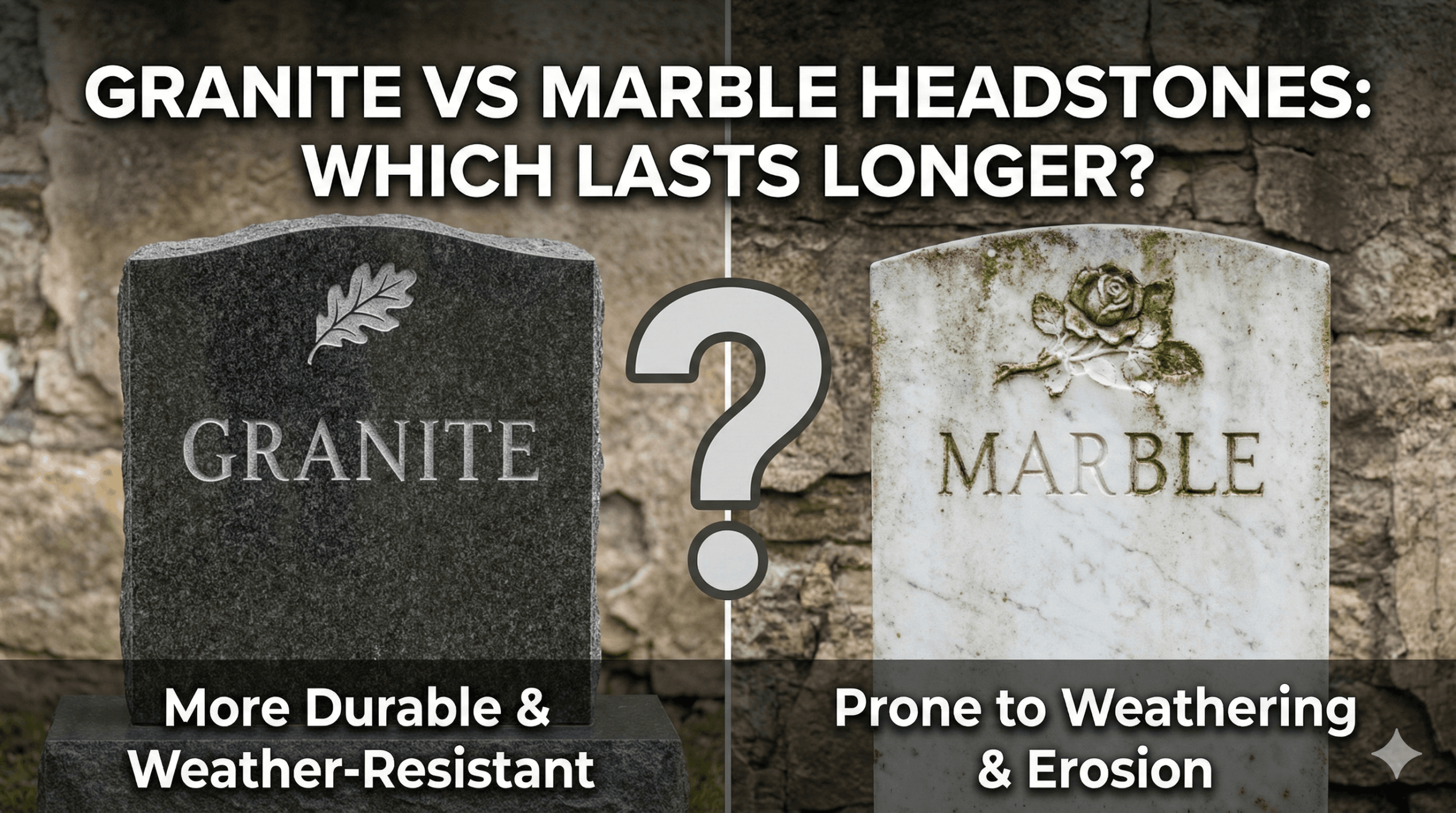
Granite vs Marble Headstones: Which Lasts Longer?
When families visit Loboda Monuments in Hudson, Ohio, one of the first questions they ask is simple but important:
“Should we choose granite or marble—and which one will last longer for our family?”
Both materials have a long history in cemeteries. At Loboda Monuments, we use premium granite and marble to create traditional headstones and cemetery monuments that are made to endure and honor your loved one’s story.
This guide walks you through the differences between granite and marble—especially how they stand up to Northeast Ohio’s climate, local cemetery rules, and everyday wear over time—so you can choose with confidence.
Granite vs Marble in a Nutshell
Before we compare longevity, it helps to understand what each stone actually is.
What is Granite?
- Type of rock: Igneous (formed from cooled magma)
- Composition: Primarily quartz and feldspar, with other minerals
- Key traits: Extremely hard, dense, and low-porosity, which makes it highly resistant to scratching, chipping, and weathering.
Monument and cemetery professionals consistently rank granite as the most durable headstone material; high-quality granite can last for many generations and even centuries with minimal maintenance.
What is Marble?
- Type of rock: Metamorphic (formed when limestone is changed by heat and pressure)
- Composition: Mostly calcium carbonate (CaCO₃), which reacts with acids in rain and the environment.
- Key traits: Softer and more porous than granite, easy to carve, with a classic, elegant look and flowing veining.
Marble has been used in monuments and sculptures for centuries, but it is more vulnerable to acid rain and other weathering processes than granite, which can cause erosion, pitting, and loss of surface detail over time.
How Long Do Granite Headstones Last?
Because of its hardness, density, and low porosity, granite is exceptionally durable outdoors:
- Monument experts note that granite deteriorates extremely slowly—on the scale of fractions of a millimeter over hundreds or even thousands of years under typical conditions.
- Many cemetery and monument resources describe granite headstones as capable of lasting centuries, often remaining structurally sound long after inscriptions on softer stones have worn away.(Milan Monuments)
At Loboda Monuments, our traditional headstones page reflects this reality: granite traditional headstones are designed to last for generations, with premium materials and professional installation on proper foundations to support long-term stability.
In Northeast Ohio, where graves experience:
- Freeze–thaw cycles
- Snow and ice
- Periodic acid rain
granite’s resistance to moisture penetration and weathering makes it the most dependable choice for long-term legibility and structural integrity.
How Long Do Marble Headstones Last?
Marble offers a beautiful, classic appearance—but its composition makes it more vulnerable outdoors, especially over longer periods:
- Because marble is mostly calcium carbonate, it dissolves slowly when exposed to acidic rain and pollution, leading to pitting, rounding of edges, and eventual loss of carved detail.
- Conservation and cemetery studies note that marble gravestones can begin to show noticeable surface roughness and inscription loss within a few decades in exposed conditions. Over 50–100 years, lettering may become difficult or impossible to read in harsher climates.
This doesn’t mean a marble headstone suddenly “fails”—the stone itself may remain standing—but the fine details and inscriptions that families cherish can soften, blur, or “sugar” (develop a grainy, crumbly surface).
In Northeast Ohio’s climate, with frequent precipitation and cycles of freezing and thawing, marble generally:
- Requires more frequent cleaning and care
- Is more prone to staining and surface erosion
- May lose crispness and polish more quickly than granite
Because of that, marble is often chosen today more for its aesthetic and sculptural qualities than for maximum outdoor longevity.
Granite vs Marble: Which Really Lasts Longer?
Looking strictly at durability and long-term legibility:
- Granite almost always outlasts marble outdoors.
- In many cemeteries, you can see the difference: older granite markers remain readable, while marble stones from similar eras have softened text, rounded details, and more visible wear.
From a practical standpoint:
- If your top priority is a memorial that stays readable for as long as possible, granite is typically the stronger choice.
- If your top priority is a certain classical look or sculptural style, marble may still be appropriate—but you should go in knowing it will likely require more care and may weather faster.
At Loboda Monuments, we offer both granite and marble traditional headstones so that you can balance longevity, beauty, and family preference—with clear guidance on what to expect over time.
Factors That Affect How Long Any Headstone Lasts
No headstone exists in a vacuum. Lifespan depends on several factors:
1. Quality of the Stone
- Higher-grade granite (dense, uniform, low porosity) performs significantly better than low-grade stone.
- The same applies to marble; some varieties weather faster than others based on their purity and internal structure.
At Loboda Monuments, we use premium-grade materials chosen for both beauty and durability.
2. Climate and Environment
- Freeze–thaw cycles can cause micro-cracks in stone that slowly enlarge over time.
- Acid rain particularly attacks marble and other calcium carbonate–based stones, leading to dissolution and surface loss.
- Shaded, damp locations or areas near trees and shrubs may experience more biological growth (lichen, moss), which can hold moisture on the stone surface.
3. Stone Finish and Design
- Polished surfaces shed water more easily and can resist staining better than rough finishes—but polished marble may lose its shine more quickly outdoors.
- Complex carvings, fine relief, and shallow lettering are more susceptible to wear than deep, bold inscriptions.
4. Installation and Foundation
- A properly engineered concrete foundation below the frost line helps prevent tilting, cracking, and shifting over time—something Loboda Monuments specifically manages as part of its design and installation process
5. Maintenance and Cleaning
- Gentle, periodic cleaning with water and a soft brush can help preserve appearance.
- Harsh chemicals, power washing, wire brushes, or home remedies like vinegar are not recommended, especially for marble, which reacts strongly to acids
- For historic or fragile stones, it’s always best to consult with professionals or follow conservation guidelines.
Cemetery Rules and Material Requirements
Most cemeteries have written rules and regulations that govern:
- Allowed materials (often granite, marble, and bronze)
- Maximum height, width, and thickness
- Whether monuments must be flat, upright, or a specific style
- Foundation requirements and placement rules
For example, some municipal cemetery codes in Ohio explicitly state that monuments and headstones must be made from granite, marble, or bronze, and they prohibit more fragile materials like wood or plaster because they don’t hold up over time.
How Loboda Monuments Helps
Families in Hudson, Akron, Cleveland, and the wider Northeast Ohio region don’t have to navigate these details alone. Loboda Monuments:
- Works directly with local cemetery offices to confirm what materials and sizes are allowed
- Handles permits and approvals required for installation
- Designs your granite or marble headstone to meet cemetery specifications while still reflecting your loved one’s personality and story
Because cemetery rules do vary, we always recommend reviewing regulations for the specific cemetery where the memorial will be placed. Our team can help interpret those guidelines and offer options that comply.
Granite vs Marble: Pros and Cons at a Glance
Granite Headstones
Pros
- Exceptional durability and weather resistance
- Holds crisp lettering and fine details for a very long time
- Wide range of colors and finishes
- Ideal for laser etching portraits and detailed artwork
- Generally lower maintenance than marble
Cons
- Still a premium material (though often comparable or slightly less expensive than marble)
- Very minor color change or surface wear can occur over many decades or centuries, especially in extreme environments
Marble Headstones
Pros
- Classic, elegant appearance with soft veining
- Easy to carve, making it well-suited for sculptural details, statues, and flowing designs
- Long tradition in historic cemeteries—some families simply love the marble look
Cons
- Softer and more porous—less durable than granite
- Prone to erosion, pitting, staining, and “sugaring” over time
- Requires more frequent maintenance to keep its appearance
- Inscriptions and fine details may become difficult to read sooner—especially in climates with acid rain and freeze–thaw cycles
What We Recommend to Families in Northeast Ohio
While every family and every memorial is unique, here’s how we generally frame the choice at Loboda Monuments:
- If you want the longest-lasting, lowest-maintenance headstone with legible lettering for generations, We typically recommend granite.
- If your highest priority is a particular marble look or sculptural style, and you’re comfortable with more maintenance and the possibility of faster weathering, Marble can still be a meaningful option.
Many families choose:
- Granite for upright traditional headstones and family monuments
- Marble for select statuary, accents, or specific artistic designs that may be placed in more protected locations
Because we offer both granite and marble traditional headstones, we’re able to walk you through real samples in our Hudson showroom and show how each responds to light, engraving, and design style.
How Loboda Monuments Helps You Choose the Right Material
Choosing a headstone is emotional, and the technical details can feel overwhelming. Our role at Loboda Monuments is to carry that burden with you, so you can focus on remembering the person you love.
Here’s how we support you:
- Personal Design Consultation
Our design consultation service gives you dedicated time with an experienced memorial specialist. Together, we’ll talk through your loved one’s story, your budget, cemetery rules, and how important long-term durability is to your family. - Material Guidance with Real Samples
You’ll be able to see and touch granite and marble samples, compare colors and finishes, and review how each material typically ages in our local climate. - Custom Design and Artwork
Whether you choose granite or marble, we can design a traditional headstone with meaningful symbols, religious imagery, portraits, or inscriptions that reflect your family’s faith and values. - Cemetery Coordination and Installation
We coordinate with the cemetery, obtain necessary approvals, plan the foundation, and professionally install your headstone so it’s secure, level, and properly supported for the long term. - Ongoing Support
If you have questions about cleaning, adding names in the future, or caring for the memorial, our team remains available to guide you.
Ready to Talk About Granite vs Marble for Your Loved One?
If you’re weighing granite vs marble headstones and want clear, compassionate guidance—not a sales pitch—our family at Loboda Monuments is here to help.
We proudly serve families throughout Hudson, Akron, Cleveland, and Northeast Ohio, offering custom granite and marble headstones that are crafted with care and designed to stand the test of time.
You don’t have to make this decision alone.
Contact Loboda Monuments today to schedule a design consultation or to begin planning a granite or marble headstone that honors your loved one’s legacy for generations.