

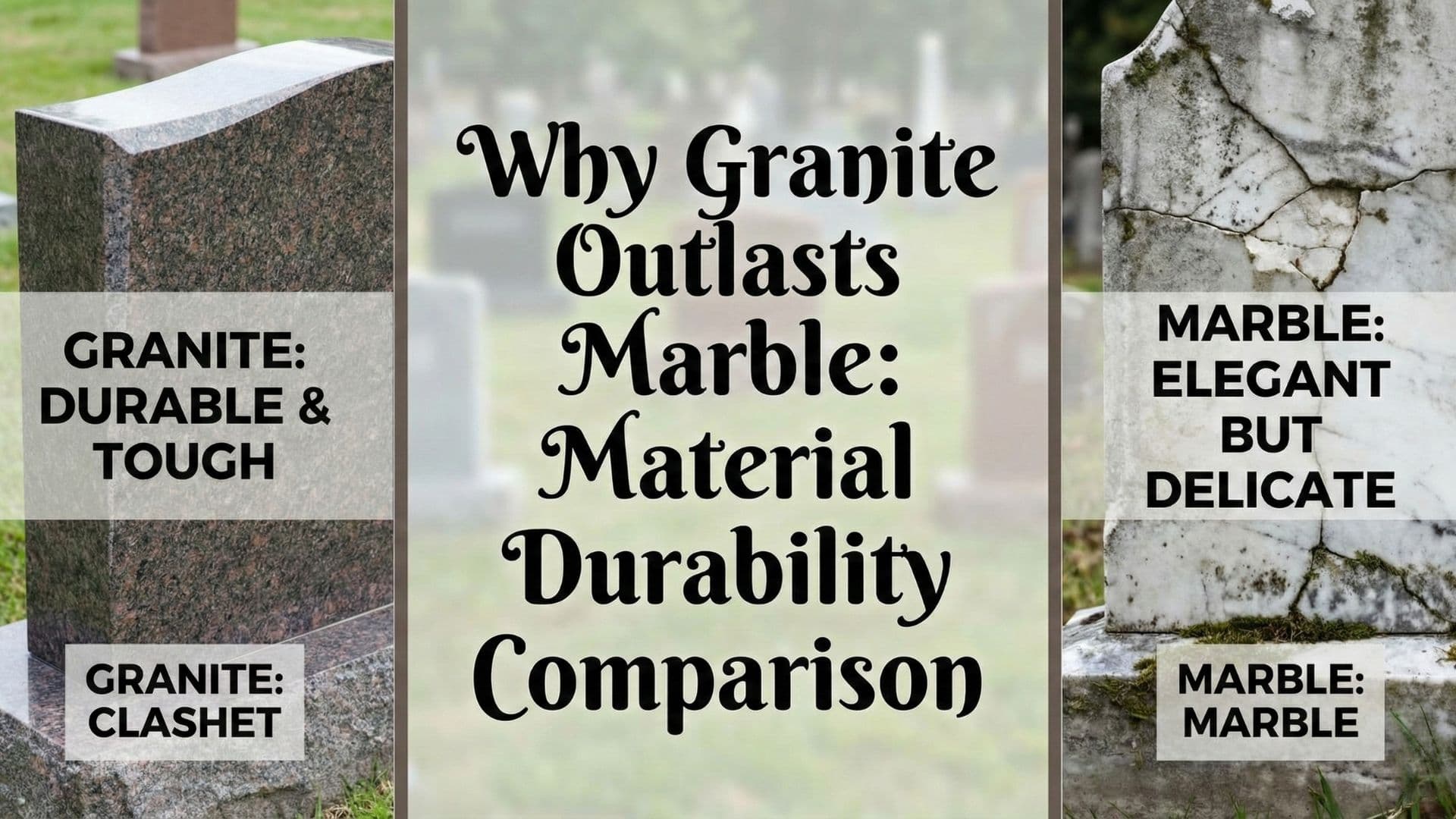
Why Granite Outlasts Marble: Material Durability Comparison
When you’re choosing a headstone or cemetery monument, durability isn’t just a “nice to have.” It’s the difference between an inscription that stays crisp for
generations and one that slowly softens, fades, or becomes harder to read over time.
Families we serve in Northeast Ohio often ask a simple question: “Will granite really last longer than marble?”
In most outdoor cemetery settings, the answer is yes—and the reason comes down to geology, chemistry, and how each stone responds to weather.
Quick Links
- TL;DR
- Summary
- Granite vs Marble at a Glance
- Why Granite Usually Outlasts Marble
- Cemetery Reality: Weather, Acid Rain, Freeze-Thaw
- Northeast Ohio Considerations
- When Marble Can Still Be a Beautiful Choice
- Care & Cleaning Tips (Do No Harm)
- How to Choose for Your Family
- Related Loboda Monuments Resources
- FAQs
- Trusted Sources
TL;DR
- Granite generally outlasts marble outdoors because it’s harder, more scratch-resistant, and less reactive to acidic rain and pollutants.
- Most cemetery marble is calcite-based (softer) and can dissolve/etch in acidic conditions, gradually reducing carved detail and readability.
- Freeze-thaw cycles and salts can accelerate damage—especially in porous stones or stones with existing cracks.
- Marble still has a place (historic look, indoor/covered spaces, certain cemetery traditions), but it typically needs more protection and care.
Summary
Granite and marble are both classic monument materials, but they behave very differently outside. Granite is a hard, durable stone made largely of minerals like
quartz and feldspar (high scratch resistance). Marble is mostly made of calcite (lower scratch resistance) and it reacts to acids—meaning acid rain, pollution,
and some cleaning products can literally dissolve the surface over time. The result: granite typically keeps its edges, polish, and lettering clarity longer,
especially in climates with rain, freezing temperatures, and seasonal changes.
Granite vs Marble: Durability at a Glance
| Durability Factor | Granite | Marble | Why it Matters for Memorials |
|---|---|---|---|
| Scratch resistance (hardness) | Usually “hard” (commonly ~6–7 range) | Softer (calcite is 3 on Mohs scale) | Harder stone keeps polish and lettering edges sharper longer. |
| Reaction to acids / pollutants | Generally more chemically stable | Acid-sensitive; can etch/dissolve | Acid rain can dissolve calcite in marble, removing detail over time. |
| Weathering outdoors | Slow, typically excellent longevity | Often faster surface loss/“sugaring” | Marble can become granular/rough, and inscriptions may soften. |
| Freeze-thaw + moisture | Usually performs very well | More vulnerable if porous/cracked | Repeated freezing can expand water in pores/cracks and cause damage. |
| Maintenance needs | Lower (gentle cleaning) | Higher (careful cleaning; avoid acids) | Wrong cleaners can accelerate marble deterioration; conservative care is key. |
Why Granite Usually Outlasts Marble
1) Granite is harder, so it resists scratching and abrasion
Hardness matters because cemeteries are tough environments—wind-blown grit, mowing equipment, shifting soil, and years of contact can slowly wear a surface.
Granite’s strength comes from its mineral makeup. Two common granite minerals are feldspar and quartz, which rank 6 and 7 on the Mohs scale,
respectively. [2][3] That’s one reason granite monuments often stay readable and well-defined for a very long time.
Marble, on the other hand, is typically dominated by calcite. Calcite ranks at 3 on the Mohs scale—meaning it scratches and wears more easily than
granite’s quartz- and feldspar-rich structure.
2) Marble is chemically vulnerable: acids can etch and dissolve it
Here’s the big durability divider: marble is acid-sensitive. In outdoor environments, acidic precipitation and air pollutants can react with the calcite in marble.
The U.S. Geological Survey explains that when acids in polluted air and rain react with calcite in marble (and limestone), the calcite dissolves—leading to roughened
surfaces, material loss, and loss of carved details.
Even mild acids can etch “calcareous” stones (stones containing calcite), which is why natural stone care guidance commonly warns against acidic cleaners like vinegar or
lemon-based products on those materials.
3) Marble can “sugar” (granular breakdown), which accelerates loss of detail
Over time, marble can develop a granular, sandy texture often called sugaring. This isn’t just cosmetic: it can reduce legibility and change how the surface holds
moisture and dirt. The National Park Service notes that marble is made of interlocking carbonate grains and that repeated cleaning campaigns (especially aggressive ones)
can loosen grains and contribute to a sugaring appearance and surface alteration.
Many historic-cemetery preservation references also describe marble’s common deterioration pathways as dissolution by acid rain and sugaring.
4) Freeze-thaw cycles and salts can compound damage
In climates like Northeast Ohio, stone is regularly exposed to wet conditions and freezing temperatures. Water can enter pores and cracks, freeze, expand, and slowly
open the stone further with repeated cycles. The National Park Service specifically warns that freeze-thaw cycles can increase stone weathering and advises avoiding
cleaning when freezing temperatures are expected.
Salts can also be a hidden culprit. The NPS explains that salts can migrate through porous stone via water, recrystallize in pores, and exert pressure that damages
the stone—one reason salt-laden cleaners are discouraged for marble headstones.
Cemetery Reality: What “Outlasting” Actually Looks Like
It’s helpful to define what families usually mean by “lasting longer.” In cemetery settings, longevity often shows up in three practical ways:
- Readability: Names and dates remain crisp and legible from a standing distance.
- Surface integrity: The face doesn’t become rough, chalky, or granular.
- Detail retention: Carving edges, religious symbols, and artwork remain sharp rather than softening over decades.
All grave markers weather over time, regardless of material. The National Park Service notes that grave marker materials naturally decay from exposure to sunlight,
wind, rain, temperature swings, and atmospheric pollutants. [8] The difference is that granite typically slows those visible changes compared to marble in
most outdoor environments.
Northeast Ohio Considerations (Hudson + surrounding areas)
If you’re selecting stone for a memorial in Northeast Ohio, durability choices should account for local conditions:
- Seasonal freeze-thaw: A real factor for long-term weathering and for timing of cleaning and installation planning.
- Rain + pollutants: Over long periods, acid-sensitive stones can lose detail and smoothness.
- Cemetery rules: Many cemeteries regulate material type, monument size, base dimensions, and installation requirements.
At Loboda Monuments, we help families navigate those realities with a concierge-style approach—so the stone you choose isn’t just beautiful today, but practical for
the cemetery and climate where it will stand.
When Marble Can Still Be a Beautiful Choice
Even though granite is usually the durability champion outdoors, marble is still chosen for meaningful reasons—and in the right setting, it can be a wonderful option.
- Historic and traditional aesthetic: Marble has a classic look that matches older family stones or historic sections.
- Indoor or sheltered placement: In mausoleums, chapels, or covered memorial areas, marble is less exposed to acid rain and freeze-thaw.
- Specific cemetery or family preferences: Some families value the material’s heritage and visual softness.
One nuance: not all marble behaves identically. Some preservation references note that dolomitic marble can be more resistant to acid damage than calcite
marble, though many cemetery marbles are the calcite type.
Care & Cleaning Tips (Do No Harm)
Whether your memorial is granite or marble, the best care principle is conservative: do the least aggressive thing that works.
Improper cleaning can do more harm than the dirt you’re trying to remove.
Safe, conservative cleaning principles
- Avoid acidic cleaners on calcareous stones like marble—acids can etch/dull the surface.
- Avoid salt-laden cleaners (and harsh chemicals) that can leave residue and contribute to damage.
- Never use wire brushes, grinders, or high-pressure washing on headstones—these can remove original surface and accelerate deterioration.
- Don’t clean in freezing conditions (or when a freeze is expected soon) because water can enter pores/cracks and expand when frozen.
- When in doubt, ask the cemetery and consult a professional—especially for older or fragile stones.
How to Choose the Right Stone for Your Family
- Start with the cemetery’s requirements. Confirm allowed materials, sizes, base dimensions, and installation rules.
- Decide what “lasting” means to you. Maximum legibility? Lowest maintenance? Matching an older family stone?
- Compare samples in real light. Outdoor lighting can change how color, contrast, and readability feel.
- Plan the inscription for long-term readability. Contrast, letter depth, and layout all matter—especially from a few steps away.
- Lean on a concierge-style consultation. You shouldn’t have to figure this out alone.
If you’d like help weighing granite vs marble for your specific cemetery and memorial goals, start with a design consultation:
Memorial & Headstone Design Consultation.
Related Loboda Monuments Resources
- Granite vs Marble Headstones: Which Lasts Longer?
- The Ultimate Guide to Granite Colors for Memorials
- Understanding Cemetery Regulations in Northeast Ohio
- Best Time to Order a Headstone (Northeast Ohio Timing Guide)
- How Much Does a Custom Monument Cost? (Pricing Guide)
- Why We Don’t Have a Sales Department—We Have a Concierge Team
FAQs
Does granite “last forever” in a cemetery?
No stone is truly permanent—everything weathers over time—but granite typically weathers more slowly than marble outdoors and tends to keep details and readability
longer in most climates.
Why do older cemeteries have so much marble if it weathers faster?
Historically, marble was widely available, relatively workable for carving, and culturally popular. Over time, many older marble stones show softened inscriptions and
surface loss consistent with acid sensitivity and weathering.
What ruins marble headstones the fastest?
Long-term exposure to acidic precipitation/pollution (dissolving calcite), plus freeze-thaw cycles and improper cleaning methods, are major contributors to faster
deterioration.
Is marble always “bad” for headstones?
Not at all. Marble can be beautiful and meaningful—especially for historic matching or indoor/sheltered placement. It simply requires more care and realistic
expectations for long-term outdoor exposure.
Can I use vinegar, bleach, or pressure washing to clean a headstone?
It’s strongly discouraged. Acidic products can etch calcareous stones (like marble), and harsh or salt-laden cleaners and aggressive methods can accelerate
deterioration. Conservative, “do no harm” approaches are recommended.
What’s the best “durability-first” choice for Northeast Ohio?
For most outdoor monuments in Northeast Ohio, granite is the typical durability-first choice due to hardness, weather resistance, and lower chemical vulnerability.
Trusted Sources
- U.S. Geological Survey (USGS) — Acid precipitation’s effect on marble/limestone: https://www.usgs.gov/faqs/how-does-acid-precipitation-affect-marble-and-limestone-buildings
- USGS — Mohs scale listing (calcite 3, feldspar 6, quartz 7): https://pubs.usgs.gov/gip/gemstones/mineral.html
- Use Natural Stone (Natural Stone Institute) — Granite hardness context & mineral basis: https://usenaturalstone.org/got-data-testing-the-performance-of-granite-engineered-quartz-concrete-and-sintered-countertop-surfaces/
- Use Natural Stone — Marble geology + calcite hardness discussion: https://usenaturalstone.org/mad-marble-geological-look-classic-stone/
- Natural Stone Institute — Consumer care guidance (avoid acids on calcareous stones): https://www.naturalstoneinstitute.org/consumers/care/
- National Park Service (NPS) — Cleaning grave markers (salts, freeze-thaw, marble surface concerns): https://www.nps.gov/articles/000/cemetery-preservation-course-cleaning-grave-markers.htm
- Michigan Historic Cemeteries Preservation Guide (PDF) — Marble dissolution by acid rain and “sugaring”: https://www.miplace.org/4a77dd/globalassets/documents/shpo/research-resources/publications/michigan-historic-cemeteries-preservation-guide.pdf
- NPS — Note on grave marker materials naturally weathering over time: https://www.nps.gov/articles/000/preserving-the-roosevelt-grave-monument.htm