
The Short Version
- A green burial means no embalming chemicals, no metal or concrete vault, and a body laid to rest in a shroud or a biodegradable casket so it can return naturally to the soil.
- Most families spend $1,500 to $4,000, compared with a national median of $8,300 for a traditional funeral with viewing and burial and $6,280 for a funeral with cremation.
- There are three kinds of green cemetery: hybrid (a natural section inside a conventional cemetery), natural (grounds dedicated entirely to the practice), and conservation (land permanently protected by an easement).
- Ohio law does not require embalming or a burial vault. Those are almost always cemetery rules, not state rules, which is why what is possible varies so much from one cemetery to the next.
- Most green cemeteries still allow a memorial, but it usually has to be a flat, unpolished, locally sourced stone. Northeast Ohio families have real options, including two of the country’s few certified conservation burial grounds.
What a Green Burial Actually Is
Most people who ask us about green burial start the conversation the same way: a little hesitantly, as though they are about to request something unusual. They are not. Green burial is simply the way nearly everyone was buried before the 1860s, and it remains the standard practice in much of the world today. What changed in the United States was the arrival of embalming during the Civil War and, later, the concrete vault as a groundskeeping convenience.
In practice, a green burial rests on three quiet decisions. The body is not embalmed with chemical preservatives, and refrigeration is used instead if there will be a delay. The body is placed in something that will break down, typically a cotton, wool, or linen shroud, or an untreated casket of pine, willow, or seagrass. And the grave holds no concrete vault or metal grave liner, so the soil sits directly against the container and decomposition proceeds the way it would anywhere else in nature.
Everything else that matters to families remains entirely possible. There can be a graveside service, hymns, readings, and grandchildren carrying the casket. There is usually still a marker, though the rules around it are different, and we will cover those in detail below. If you are also weighing what a conventional burial involves, our guide to cemetery plot costs lays out the traditional side of the same decision.
Why Families Are Asking About It Now
Interest has grown steadily and quickly. The National Funeral Directors Association reports that 61.4 percent of consumers say they would be interested in exploring green funeral options, and cemeteries around the country have reported roughly a 72 percent increase in demand for green burials. Among people aged 40 and older, about 11 percent already name green burial as their first preference.
Part of that is generational. A great many Baby Boomers arranged conventional funerals for their own parents, found the experience heavier and more expensive than they expected, and decided they wanted something simpler for themselves. Part of it is the arithmetic of what conventional burial puts into the ground. Each year in the United States, cemeteries bury roughly 1.6 million tons of reinforced concrete in vaults, about 90,000 tons of steel in caskets, and an estimated 827,000 gallons of embalming fluid containing formaldehyde.
of American consumers say they would be interested in exploring green funeral options (NFDA)
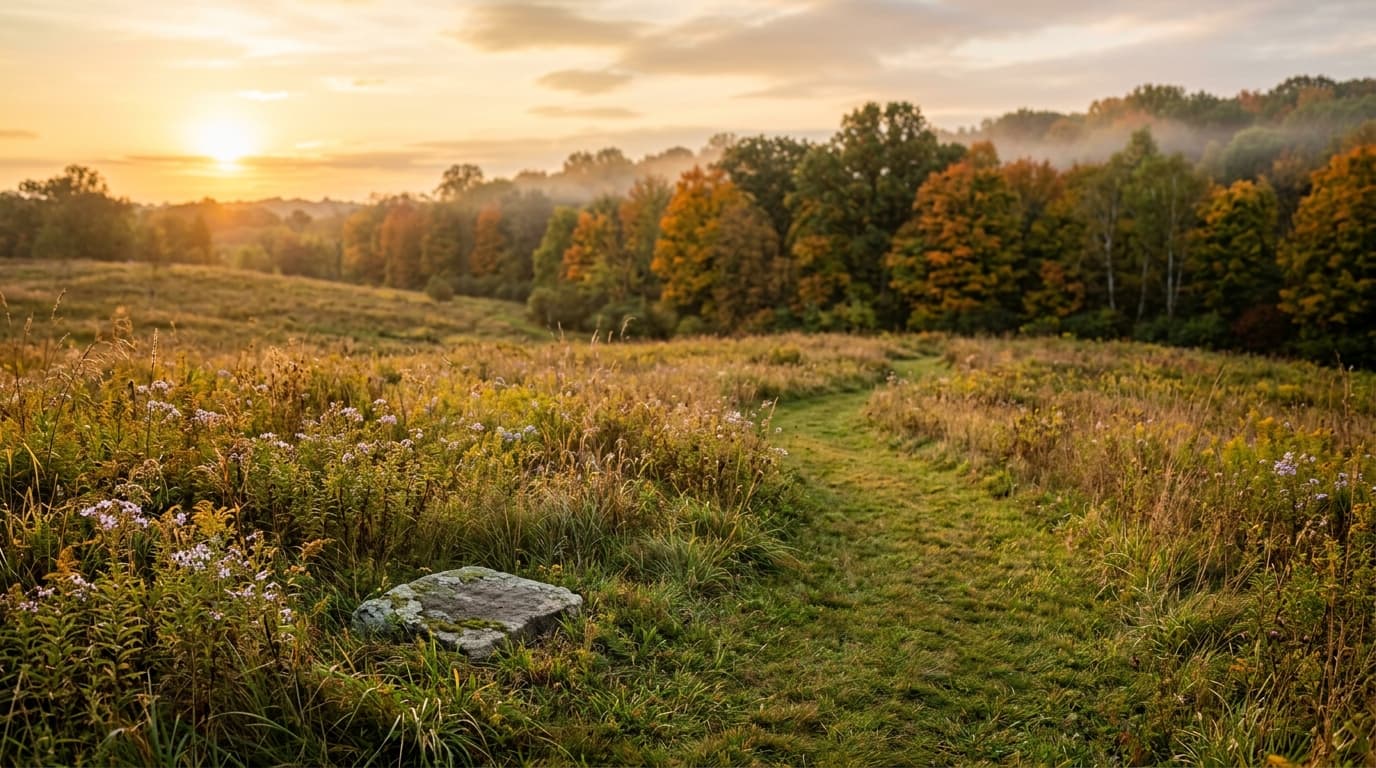
But the reason families give us most often is neither statistical nor environmental. It is that a natural burial ground feels like the kind of place their mother or father actually loved. A meadow in September, a stand of oaks, birdsong instead of mower noise. For some families that resonance matters more than anything else on the list.
The Three Kinds of Green Cemetery
This is where most confusion starts, because “green cemetery” describes three genuinely different things. The Green Burial Council, the nonprofit that sets and certifies standards in North America, recognizes three categories, and the differences affect cost, rules, and what your memorial can look like.
| Type | What It Is | What to Expect |
|---|---|---|
| Hybrid burial ground | A conventional cemetery with a designated natural section | No vault required, biodegradable containers allowed. Often the easiest option, and frequently the only one within a short drive. Marker rules may be closer to conventional. |
| Natural burial ground | Grounds dedicated entirely to natural burial | No toxic chemicals, no vaults, no non-native stone markers, and no containers that are not plant-derived or natural. Pesticide-free grounds management is required. |
| Conservation burial ground | A natural burial ground held with a conservation partner | All the natural standards, plus a conservation management plan and permanent protection of the land through an easement or deed restriction. The rarest and most restrictive category. |
If you want a green burial but also want your family buried together in the cemetery they already use, ask specifically whether that cemetery has a hybrid or natural section. A surprising number of established cemeteries have quietly added one in the past decade and simply do not advertise it.

The essentials of green burial at a glance: what defines it, what it costs, and the three kinds of green cemetery.
What a Green Burial Costs in 2026
Green burial is usually less expensive than conventional burial, though not always dramatically so, and it is generally more than a direct cremation. Most families land somewhere between $1,500 and $4,000 all in, with the widest published range running from about $2,300 to $12,000 depending on region and level of service. For comparison, the national median cost of a funeral with viewing and burial was $8,300, and a funeral with cremation was $6,280.
The savings come from three specific line items that simply are not purchased: embalming, a sealed metal casket, and a concrete outer burial vault. Here is roughly how the pieces break down.
| Item | Typical 2026 Cost | Notes |
|---|---|---|
| Plot in a green cemetery | $1,000 to $4,500 | Conservation grounds sit at the higher end; a hybrid section is often priced like the rest of the cemetery. |
| Opening and closing | $500 to $1,500 | Often lower than conventional burial because no vault has to be set. |
| Burial shroud | Under $500 | Cotton, linen, wool, hemp, or bamboo. Often paired with a simple carrying board. |
| Biodegradable casket | $200 to $2,500 | Most families choose willow, seagrass, or untreated pine in the $1,000 to $1,500 range. |
| Embalming | $0 | Not performed. Refrigeration is used if there is any delay before the service. |
| Vault or grave liner | $0 | Prohibited outright at natural and conservation grounds. This is often the single largest saving. |
| Natural stone marker | $400 to $1,800 | Where permitted. Cost depends on the stone, the size, and the depth of the engraving. |
Two things worth knowing before you build a budget. First, funeral home professional fees are separate from all of the above and still apply if a funeral director is involved. Second, green burial is often more expensive than a direct cremation, so if cost alone is the deciding factor, it is worth reading our guide to cremation urns and cremation memorial options alongside this one. If you are comparing memorial costs specifically, our 2026 headstone pricing guide covers the marker side in detail.
Green Burial in Ohio: The Law and the Places
Here is the part that surprises most Ohio families. Ohio has no law requiring embalming, except in narrow circumstances such as transporting a body across state lines by common carrier or when burial is delayed for an extended period, and refrigeration is an accepted alternative. There is also no state law requiring a burial vault, and Ohio does not require a casket for burial at all. The health department can require prompt burial or cremation in the case of certain communicable diseases, but that is the exception rather than the norm.
Which means that when a cemetery tells a family that a vault is required, that is almost always the cemetery’s own rule rather than the State of Ohio’s. It is a legitimate rule, and cemeteries have practical groundskeeping reasons for it, but it is negotiable in the sense that a different cemetery may see it differently. Our overview of cemetery regulations in Northeast Ohio explains how much these rules vary from one set of gates to the next.
Ohio also happens to be unusually well served. Foxfield Preserve in Wilmot, Stark County, opened in 2008 on 43 acres of conservation land just south of Akron and is one of only a small number of certified conservation burial grounds in the country, with plots around $4,000. Kokosing Nature Preserve in Gambier sits on 23 acres of restored prairie and woodland and was the first conservation burial ground in the nation affiliated with a college land conservancy, through Kenyon College’s Philander Chase Conservancy. Beyond those two, a growing number of conventional Ohio cemeteries have added hybrid natural sections.
Families often tell us the hardest part was not choosing green burial. It was worrying that choosing something simpler might look like caring less. It does not. A shroud and a fieldstone in a meadow can hold every bit as much love as polished granite, and often the person being honored chose it precisely because it was theirs.
What Kind of Memorial Is Allowed?
This is the question we field most often, and it deserves a careful answer, because the assumption that green burial means no memorial at all is the single most common misunderstanding we encounter. In most cases a memorial is permitted. It simply has to work with the landscape rather than stand out from it.
Where markers are allowed, natural and conservation burial grounds typically require all of the following:
- Natural materials only. Stone is the most common. Some grounds also permit wood or found natural objects. Bronze, concrete, and imported granite are usually excluded.
- Local or regional stone. Many natural burial grounds explicitly prohibit non-native stone, which rules out the imported granites used in most conventional monuments.
- Flat placement. The marker lies flush with or just above grade rather than standing upright, so it does not interrupt the meadow or obstruct mowing and controlled burns.
- Unpolished and uncut faces. Polished, machine-shaped stone is frequently excluded because it reads as manufactured. A cleft or natural face with engraved lettering is the usual compromise.
- Modest size. Limits vary, but a common specification is no larger than roughly 2 feet by 1 foot, with a minimum thickness around 4 inches so the stone stays put.
Some grounds go further and permit no individual marker at all, memorializing everyone instead on a shared stone or register at the entrance, and offering GPS coordinates so families can find the exact spot. Others allow a native tree or shrub to be planted in place of a stone. There is no universal rule, which is exactly why the marker conversation should happen before the plot is purchased rather than after.
Practically, a green burial marker sits somewhere between a conventional flat grave marker and an uncarved fieldstone. The engraving question matters too. Hand-carved or sandblasted lettering on a natural cleft face weathers gracefully and is generally accepted, while the crisp laser work described in our comparison of laser etching and traditional engraving usually requires the polished surface that natural grounds prohibit. And because the inscription is often shorter than on a conventional monument, every word carries more weight. Our collection of headstone inscription ideas is a good place to start when you have room for only a name, two dates, and a single line.
Before you commit to any memorial for a green burial, get the cemetery’s written marker specification. Ask for the permitted materials, maximum dimensions, minimum thickness, finish restrictions, and whether the stone must be locally quarried. We do this for families as a matter of course, and it prevents the heartbreak of a stone that has to be sent back.
Green Burial, Cremation, or Traditional Burial?
Families often arrive assuming these are three points on a single scale from simple to elaborate. They are not. Each one trades away something different.
Traditional burial offers the most familiar experience and the widest range of memorialization, including the upright monuments and companion designs many families picture when they think of a cemetery. It costs the most, and it uses the most material. If that is the direction you are leaning, our guides to granite headstones and headstone designs cover the options.
Cremation is now the most common choice in the United States, with a projected rate above 63 percent, and it offers the most flexibility around timing and location. It is worth knowing that cremation is energy-intensive, which is why some families interested in green options end up choosing burial after all. Cremated remains can still be interred in most green cemeteries, and options such as columbarium niches remain available on the conventional side.
Green burial sits between the two on cost and asks the most of a family in terms of planning, because there are fewer providers and the rules are less uniform. What it offers in return is a burial that is straightforward, materially light, and, for many people, more personal. It is also the only option of the three where the burial itself actively protects a piece of land.
How to Plan a Green Burial: A Practical Sequence
If you are pre-planning, you have the luxury of doing this in order. If you are arranging things after a death, the first two steps are the urgent ones and the rest can follow in the weeks after.
- Find the cemetery first, not the funeral home. Green burial is constrained almost entirely by where it is permitted. Search for certified grounds and, just as importantly, call the conventional cemeteries near you and ask whether they have a natural section.
- Ask for the rules in writing. Vault policy, embalming policy, permitted containers, grave depth, and marker specifications. A cemetery that takes green burial seriously will have this documented.
- Confirm the container. Shroud or biodegradable casket, and whether the cemetery has a preferred supplier. Ask whether a carrying board is needed for a shroud burial.
- Choose a funeral home that has done this before. Ask directly how many green burials they handled last year. Refrigeration instead of embalming requires a bit of planning around the service date.
- Plan the memorial early. Get the marker specification before you order anything, and confirm whether the stone must be locally sourced. Our guide to when to order a headstone in Northeast Ohio explains why lead times matter more here than most families expect.
- Write it down and tell someone. Green burial only happens if the people making decisions know it was wanted. Put it in writing and give a copy to whoever will be making the call.
How We Can Help
Reserve Memorials is a family-owned memorial company in Hudson, Ohio, and we work with more than 4,100 cemeteries across the state, including natural and hybrid burial grounds. When a family chooses green burial, our role is usually the same as always: to find out exactly what the cemetery will allow, to design a memorial that honors the person within those limits, and to handle the approval, foundation where one is needed, and installation.
Sometimes that is a cleft-faced fieldstone with hand-cut lettering. Sometimes it is a name added to a shared memorial wall. Sometimes a family decides green burial is not right for them after all, and that is a perfectly good outcome too. There is never a charge to ask a question, and never any pressure. Call us at (234) 269-5432 or schedule a free consultation whenever you are ready.
Frequently Asked Questions