

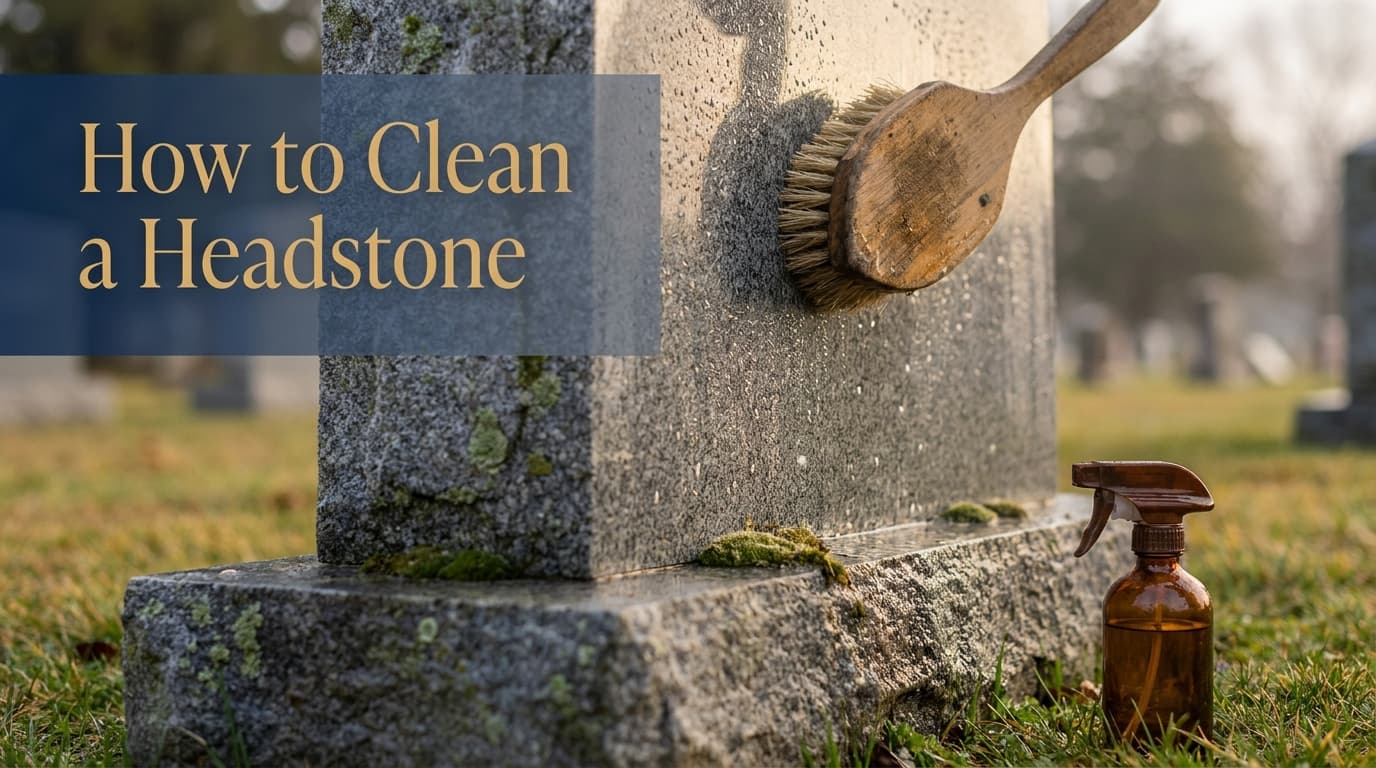
TL;DR: Headstone Cleaning, Done Safely
- Always ask the cemetery first. Most cemeteries permit family cleaning, but many require notice or restrict certain products.
- Inspect before you scrub. If you see cracks, flaking, sugaring, or loose lettering, stop and call a memorial professional.
- Use only water, soft brushes, and approved biological cleaners like D/2. Never use bleach, household soap, wire brushes, or pressure washers.
- Work bottom-up. Soak the stone, scrub gently from the base toward the top, and rinse thoroughly so no residue is left behind.
- Plan for once a year, not “like new.” The goal is to remove biological growth and pollution, not to strip the stone of its natural patina.
A Quiet Act of Remembrance
Standing at the grave of someone you love, the small things matter. A bouquet, a few clean lines on the stone, a name visible again after a winter of weather and lichen. Cleaning a headstone is one of the gentlest ways to keep a memory alive, but it is also one of the easiest places to do real, lasting harm if you reach for the wrong bottle under the kitchen sink.
This guide walks you through the safest way to clean a granite, marble, or bronze memorial, what to absolutely avoid, when to call a professional, and how to make the visit feel like the quiet ritual it is meant to be. Reserve Memorials has cared for headstones in cemeteries across Northeast Ohio for decades. The methods below come straight from the standards used by the U.S. National Park Service, the National Cemetery Administration, and the conservators we work with on monument restoration every week.
Cleaning a headstone is care work. Take your time. Bring water, bring patience, and bring someone who loved them too if you can.
Before You Start: Three Things That Matter Most
1. Get permission from the cemetery
Every Ohio cemetery sets its own rules for monument care. Many municipal and private cemeteries permit families to clean their own family stones, but a quick call to the office is always worth the courtesy. National cemeteries and historic burying grounds often have stricter policies and may ask that only trained volunteers or contracted conservators perform cleaning. If you are unsure who manages the grounds, our cemeteries we serve directory is a good starting point for Hudson, Stow, Akron, Cleveland, and the surrounding communities.
2. Inspect the stone for damage
Before you wet a single bristle, run your eyes (and very gently your fingers) over the stone. Look for hairline cracks, flaking on the face of the marker, sugaring (a sandy, granular surface common on weathered marble), loose lettering, or anywhere the stone feels soft or chalky. Any of these signs mean the headstone needs a conservator, not a sponge. Cleaning a compromised stone can pop pieces of the surface clean off.
A useful rule of thumb: if a thumbnail leaves a mark on the stone surface, the stone is too fragile to clean. Older marble stones from the 1800s and early 1900s are most at risk.
3. Pick the right day and bring enough water
A mild, overcast day is ideal. Direct sun or summer heat will cause cleaning solution and rinse water to evaporate too fast, which leaves streaks and can drive minerals into the pores of the stone. The National Park Service recommends working only when air and surface temperature are 45°F or above. For a standard upright headstone, plan on at least five gallons of clean water for the rinse. If the cemetery has no spigot near the section, bring jugs.
What You Will Need (and What to Leave at Home)
| Bring | Leave at Home |
|---|---|
| 5+ gallons of clean water | Bleach or any chlorine cleaner |
| Soft, natural-bristle brushes (no metal, no dye) | Wire brushes or steel wool |
| Large, undyed sponges | Dish soap, laundry detergent, or vinegar |
| Plastic or wooden scraping tools (popsicle sticks work well) | Power washers or garden-hose jet nozzles |
| D/2 Biological Solution (the NPS-tested standard) | Acids, ammonia, or any “miracle” stone cleaner |
| Spray bottle for water mist | Putty knives or metal scrapers |
| Knee pad and a small bucket | High expectations of “brand new” |
The only biological cleaner endorsed by both the U.S. National Park Service and the VA National Cemetery Administration for use on government-issued headstones.
The Universal Cleaning Method (Granite and Most Modern Stones)
This is the safe, slow, water-first approach used in cemeteries from Arlington to your local Ohio churchyard. It works on the vast majority of modern granite memorials, and it is gentle enough to use on most marble and limestone too.
Step 1: Pre-clean by hand
Pick away leaves, grass clippings, and loose dirt from the base and the engraved letters. Use a popsicle stick or a soft plastic pick for anything stuck in the lettering. Take your time around photographs, ceramic insets, or photo memorial panels, these are the most fragile surfaces on the stone.
Step 2: Soak the stone with clean water
Wet the entire headstone with plain water and let it sit for a few minutes. A pre-soaked stone will not pull cleaning solution into its pores, which protects against streaking and discoloration.
Step 3: Apply D/2 Biological Solution
Spray or sponge undiluted D/2 over the entire face of the stone, top to bottom. The product is non-acidic, non-caustic, and safe to leave on without rinsing immediately. Let it dwell for 10 to 15 minutes. You will sometimes see lichen and algae start to lift on their own.
Step 4: Scrub gently, bottom up
Working from the base toward the top, scrub in small circles with a soft natural-bristle brush. Bottom-up scrubbing keeps dirty water from running over freshly cleaned areas and leaving tide marks. For lettering, switch to a smaller brush, an old soft toothbrush is perfect for getting inside engraved characters and around decorative font work.
Step 5: Rinse thoroughly
Rinse with clean water until no foam, residue, or color is coming off. This is where the five gallons earn their keep. A poorly rinsed stone will keep “cleaning” itself for weeks, which over time causes uneven weathering. Mist the stone again at the end and walk around it once to check for any spots you missed.
Step 6: Walk away. Come back in a few weeks.
D/2 keeps working long after you have packed up. Stains and biological growth that did not lift on the first pass will continue to fade over the following weeks and months. A single thorough cleaning per year is enough for most family stones in Northeast Ohio.

The six-step universal headstone cleaning method, adapted from National Park Service and VA NCA best practices.
Special Cases: Marble, Bronze, and Old Limestone
Cleaning a marble headstone
Marble is softer and more porous than granite, which means it weathers faster and stains more easily. The same water-and-D/2 method works, but use even softer bristles and skip any scraping. If the stone is sugaring (the surface feels gritty when you brush it), do not clean it at all. That stone needs a conservator. Many of the older upright stones in pioneer cemeteries around Hudson, Stow, and Akron fall into this category.
Cleaning a bronze grave marker or veteran plaque
Bronze is a different animal. It does not lichen the way stone does, but it darkens and develops a green or brown patina from oxidation. The VA National Cemetery Administration’s guidance for flat bronze veteran markers is straightforward:
- Rinse with clean water and lightly brush off dirt with a soft, non-metal bristle brush.
- Wash with warm water and a small amount of mild, non-detergent soap (Ivory or Murphy’s Oil Soap are the conservator standards).
- Rinse completely.
- Once dry, apply a thin coat of paste wax made for bronze (Trewax or Johnson’s). This protects the finish and slows future patina.
Never use brass cleaner, lacquer, or polishing compounds on a bronze veteran plaque. They damage the patina the VA expects to see and can violate national cemetery policy. If a bronze marker is severely tarnished or pitted, the family can request replacement at no cost through the VA. Our team can walk you through that paperwork as part of our veteran memorial service.
Cleaning a sandstone or limestone marker
These are common in Ohio’s oldest cemeteries, fragile, irreplaceable, and almost always best left to a trained conservator. A wet sponge and gentle water rinse are usually safe; anything more is not. If the inscription is fading, do not chase legibility with a brush. We can document and preserve the stone with conservation-grade techniques instead.
Veterans, military families, and Gold Star families: Reserve Memorials provides complimentary inspection of bronze and granite VA markers in the cemeteries we serve. Reach us through our veteran memorial program if you have questions about cleaning, replacement, or restoration.
What to Absolutely Never Do
The shortlist of things that quietly destroy headstones is longer than most families realize. The big ones:
- Bleach, ammonia, and “shower” cleaners. They penetrate stone, leave behind salts that re-emerge as white blooming, and can permanently discolor granite and marble.
- Vinegar and citrus cleaners. The internet loves this hack. Conservators do not. Acids etch marble and limestone in seconds and dull the polish on granite over time.
- Power washers. Even on a low setting, the pressure can blast lichen out of the stone along with chunks of the stone itself. The VA explicitly prohibits power washing on government-furnished markers.
- Wire brushes, steel wool, sandpaper. Any metal abrasive will leave iron particles in the pores of the stone that rust into orange streaks within months.
- Rubbings as a “clean.” Pressing paper and crayon into a fragile inscription can spall the surface. If you want a record of the inscription, photograph it.
- Fixing your own crack. Caulk, epoxy, and DIY patching are reversible only by a conservator working at considerable cost. Call us first.
When to Call a Memorial Professional
Some jobs are just not DIY work, and admitting that is its own form of care. Reach out to a memorial company or stone conservator if you see any of the following:
- Cracks that go through the body of the stone, not just the surface.
- Lettering that is loose, lifting, or filled with cracked lead.
- The stone is leaning, sinking, or has separated from its base, this is a foundation issue, not a cleaning issue.
- Vandalism, paint, or graffiti.
- Heavy biological growth that has not responded to two seasons of D/2 application.
- Any work on a stone that is more than 100 years old.
If you are not sure where the line is, send us a few photos. Our consultations are free, and we would rather tell you “this is safe to clean yourself” than have you discover too late that it was not. The same conservators who handle monument restoration across Northeast Ohio can also help with foundation repair, re-lettering, and full memorial restoration.
A Gentle Annual Rhythm
Many families build headstone care into a meaningful seasonal ritual. Spring, after the last frost, is ideal in Ohio. The cleaner has time to keep working through the warm months, the stone is dry by Memorial Day, and you avoid the freeze-thaw cycles that cause damage if water is left in cracks. If you only visit once a year, that is enough. The goal is not a stone that looks new. It is a stone that is cared for.
If you are planning a new memorial or thinking ahead about a companion headstone for a spouse, this is also a good moment to think about how the stone will weather. Modern barre and Indian black granite are much more forgiving than older marbles, and our team can help match a stone material to a cemetery’s microclimate. Cost is always a factor too, our 2026 monument pricing guide walks through what families typically invest in a lasting tribute.
Frequently Asked Questions
How often should I clean a headstone?
Once a year is plenty for most family stones in Ohio. Cleaning more frequently is not gentler, it just multiplies wear on the stone surface. If the headstone is in heavy shade or near trees that drop sap and leaves, you may see biological growth more quickly, but a single annual D/2 application keeps it under control.
Can I use Dawn dish soap or vinegar to clean a headstone?
No. Household soaps leave a film that attracts dirt and slowly degrades the polish. Vinegar is mildly acidic and will etch marble, limestone, and the polished face of granite over time. The VA National Cemetery Administration and the National Park Service both recommend plain water and, where needed, a biological cleaner like D/2.
Where can I buy D/2 Biological Solution?
D/2 is sold through D2BIO, gravestone-specialty retailers, and several conservation suppliers online. A one-quart bottle is enough for several headstones and lasts indefinitely on the shelf. Reserve Memorials keeps a small supply for families we serve in Hudson and the Greater Akron-Cleveland area, call us if you need a starter bottle.
Do I need permission from the cemetery to clean a family headstone?
Most Ohio cemeteries allow family members to clean their own stones, but every cemetery sets its own rules. Some require advance notice, some prohibit certain products, and historic or national cemeteries may restrict cleaning to trained volunteers and contracted conservators. A short call to the cemetery office before your visit avoids any awkwardness on the day.
How much does professional headstone cleaning or restoration cost?
Professional cleaning of a single upright family stone typically runs between $150 and $400 in Northeast Ohio, depending on size, condition, and whether biological growth treatment is needed. Full restoration, re-leveling, re-lettering, foundation repair, is a separate quote. Reserve Memorials offers free in-cemetery inspections and written estimates with no obligation.