
The Short Version
- The U.S. Department of Veterans Affairs provides a free headstone, grave marker, or bronze medallion for eligible veterans buried in any cemetery in the world, public or private.
- Five marker styles are available: upright granite or marble, flat granite or marble, flat bronze, bronze niche markers (for columbarium niches), and three sizes of bronze medallion for existing private headstones.
- Eligibility usually requires honorable or general (non-dishonorable) discharge and, for most post-1980 service, at least 24 months of continuous active duty. Spouses and dependent children buried in national or state veterans cemeteries are also eligible.
- Families apply by submitting VA Form 40-1330 (for headstones/markers) or VA Form 40-1330M (for medallions on private stones), together with the DD-214 or equivalent service record.
- The VA covers the marker itself but not setting, foundation, or inscription fees at a private cemetery. Reserve Memorials handles the paperwork, the foundation, and the installation as part of our veteran memorial services for families across Northeast Ohio.
A Promise the Country Makes to Every Veteran
The United States makes a quiet promise to every person who served honorably in the armed forces: when the time comes, the country will mark the grave. The marker is provided at no cost by the U.S. Department of Veterans Affairs, and it has been provided in some form for more than 150 years — since the years just after the Civil War, when Congress first authorized headstones for Union soldiers.
In 2026 the program is broader than most families realize. The VA will furnish an upright granite or marble headstone, a flat granite or marble marker, a flat bronze marker, a bronze niche marker for cremated remains in a columbarium, or a bronze medallion that can be affixed to a privately purchased stone. The marker is free, and so is the lettering and emblem. But there are eligibility rules, application steps, and details about delivery and installation that catch families off guard at exactly the wrong time. This complete 2026 guide walks through every part of the benefit, in plain language, so the family of a veteran can make the right choices with confidence.
At Reserve Memorials, we have helped hundreds of veteran families in Hudson, Akron, Cleveland, Stow, and the more than 4,100 cemeteries we serve across Ohio navigate this paperwork. We handle the VA forms, the cemetery approval, the foundation, and the setting — so the family can focus on the memory rather than the bureaucracy. Our work on flat grave markers covers a portion of this story, but veteran families repeatedly tell us they want the full picture of what the VA provides. That is what this guide is.
Who Is Eligible for a VA Headstone or Marker
Eligibility for a government-furnished headstone, marker, or medallion rests on two main pillars: the nature of the discharge and the length and dates of service. The general rule, as set out in 38 CFR 38.630 and the VA’s National Cemetery Administration policy, is that any veteran whose discharge was anything other than dishonorable is eligible. A service member who dies on active duty is automatically eligible.
Service Length Requirements
For enlisted personnel who entered service after September 7, 1980, or officers who entered after October 16, 1981, at least one of the following must also be true:
- The veteran served a minimum of 24 months of continuous active duty, or
- The veteran served the full period for which they were called or ordered to active duty (Reservists and National Guard activated under Title 10 typically qualify), or
- The veteran died while on active duty.
Veterans who served before those 1980/1981 dates are generally eligible without the 24-month requirement, provided the discharge was not dishonorable.
Spouses and Dependent Children
The benefit extends to family members in specific circumstances. A spouse, surviving spouse, or dependent child who is buried in a national cemetery, a state or tribal veterans cemetery, or a military post or base cemetery may receive a government headstone or marker. Importantly, the spouse can be eligible even if they pass away before the veteran. In a private cemetery, however, the VA generally does not provide a marker for the spouse — only for the veteran — though some families choose to inscribe both names on a single privately purchased companion stone. Our guide on double headstones for husband and wife walks through that companion-memorial path in detail.
When a Private Marker Already Exists
A separate rule applies when a veteran already has a privately purchased headstone in a private cemetery. In that case, the family has two choices: request a second, government-furnished marker to place beside the existing stone, or apply for a bronze VA medallion that is affixed directly to the existing stone. Both are free. Most families now choose the medallion route because it preserves the family’s original headstone and adds the official mark of veteran status without changing the design.
A small but important nuance: a veteran who died on or after November 1, 1990 and whose grave is already marked with a privately purchased headstone is eligible for a second government marker to be placed in addition to the private stone. The eligibility window before that date is narrower, which is why families with older graves usually choose the medallion.
The Five Types of VA-Furnished Markers
The VA’s National Cemetery Administration furnishes five distinct styles. Each is sized and finished to a federal standard, with the veteran’s name, dates, branch of service, and an optional approved religious or service emblem.
| Marker Type | Dimensions | Weight | Best For |
|---|---|---|---|
| Upright granite or marble headstone | 42″ L × 13″ W × 4″ thick | ~230 lbs | National cemeteries and sections that allow upright stones |
| Flat granite or marble marker | 24″ L × 12″ W × 4″ thick | ~130 lbs | Cemeteries that require flush, lawn-level markers |
| Flat bronze marker | 24″ L × 12″ W with 3/4″ rise | ~18 lbs | Cemeteries permitting bronze on a private granite base |
| Bronze niche marker | 8 1/2″ L × 5 1/2″ W × 7/16″ rise | ~3 lbs | Columbarium niches holding cremated remains |
| Bronze medallion (small / medium / large) | 2″ / 3-3/4″ / 6-3/8″ wide | < 2 lbs | Affixed to an existing privately purchased headstone |
Each marker carries an inscription that includes the veteran’s full name, branch of service, rank or rate (if requested), war service, dates of birth and death, and one approved emblem of belief. The VA maintains a catalog of more than seventy religious and secular emblems, ranging from the Latin Cross and Star of David to the Buddhist Wheel of Righteousness, the Unitarian Universalist flame, the atheist symbol, and many others added in recent decades. Families can also request unit insignia, the Medal of Honor emblem when applicable, or service ribbons within the available space.
Total cost of the VA-furnished marker, including engraving, emblem, and standard shipping to the cemetery or funeral home of record.
How to Apply: VA Form 40-1330 Step by Step
The single form that drives almost every VA headstone or marker request is VA Form 40-1330, Claim for Standard Government Headstone or Marker. The form is short — only three pages of fillable boxes — but small mistakes commonly delay an application by weeks. Here is the path we walk families through.
Step 1: Gather the supporting documents
Before opening the form, collect:
- The veteran’s DD Form 214 (Certificate of Release or Discharge from Active Duty) or equivalent service record. The WD AGO 53-55 covers most World War II Army veterans; reserve and Guard members use NGB Form 22 or equivalent.
- The deceased’s full legal name, dates of birth and death, place of birth, and Social Security number.
- The name and full address of the cemetery, including the section, lot, and grave number if available.
- The name, address, and signature of the cemetery’s authorized point of contact (the cemetery must agree to receive and set the marker).
Step 2: Complete the form
Block-by-block, the form asks for the personal information above, the type of marker selected (upright granite, flat bronze, niche, etc.), the inscription text, and the chosen emblem of belief. The applicant — usually the next of kin — signs in Block 27 and the cemetery representative signs in Block 30 attesting that the marker can be set at the named location.
Step 3: Submit
There are three accepted submission paths: by mail to the Memorial Programs Service in Quantico, Virginia; by fax to 1-800-455-7143; or by email as a single PDF attachment to mps.headstones@va.gov. The VA strongly recommends keeping a copy of every page, since corrections sometimes have to be filed mid-process.
Step 4: Wait, then receive
Delivery time runs 30 to 60 days for most marker types, with bronze markers occasionally taking up to 90 days during peak production. The VA ships directly to the cemetery or to a designated funeral home. Once it arrives, the family or the cemetery is responsible for actual installation.

VA-furnished headstone and marker types, eligibility, and the VA Form 40-1330 application path for Northeast Ohio veteran families.
The VA Bronze Medallion: A Modern Path for Existing Stones
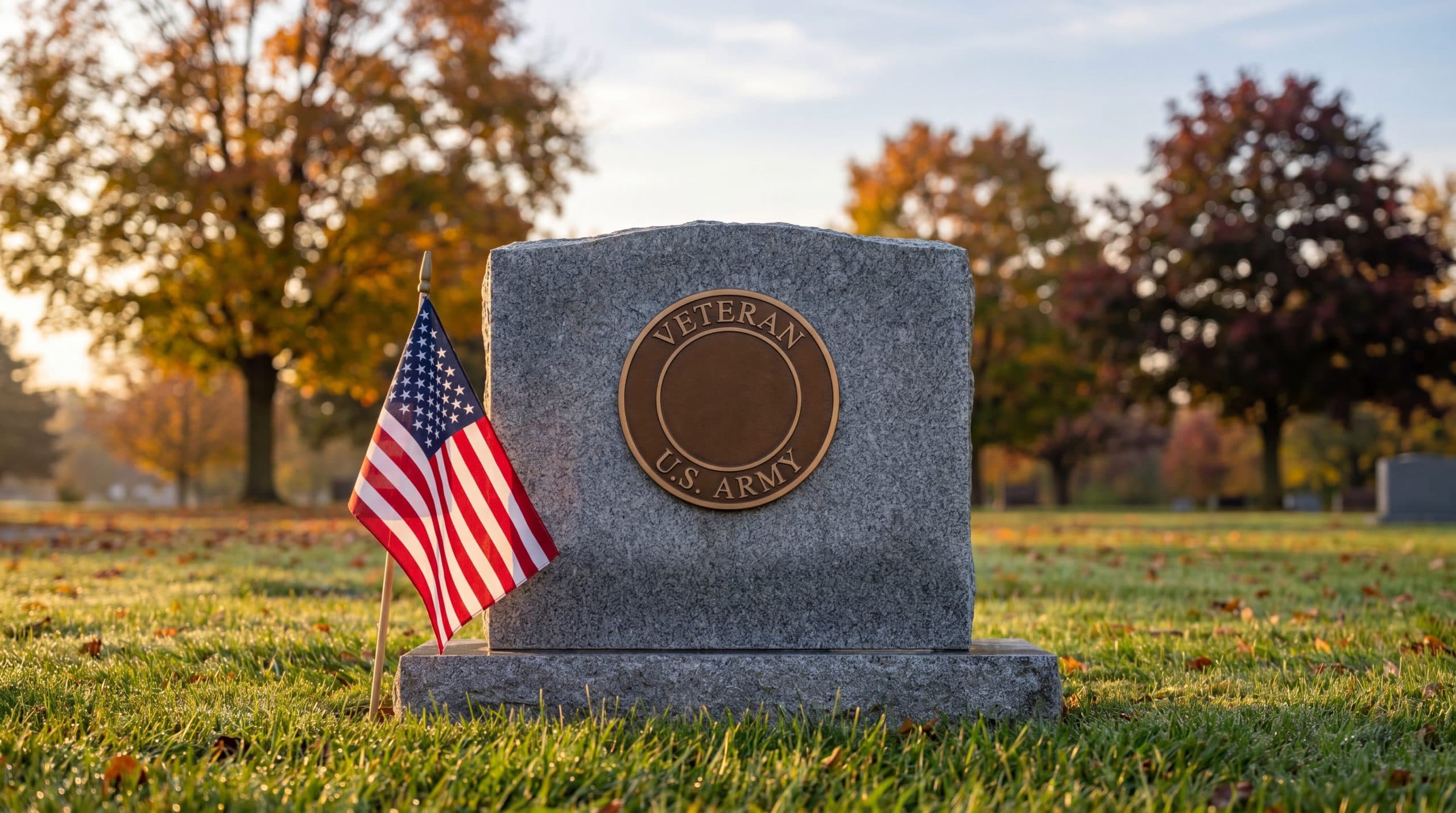
For families whose loved one already has a privately purchased headstone, the bronze medallion is often the cleanest way to add official veteran recognition. The medallion is cast bronze, inscribed with the word VETERAN across the top and the branch of service across the bottom (Army, Navy, Marine Corps, Air Force, Space Force, or Coast Guard). It is provided in three sizes:
- Small: 2″ wide × 1 1/2″ tall × 1/3″ deep — best for flat markers or small upright stones.
- Medium: 3 3/4″ wide × 2 7/8″ tall × 1/4″ deep — the most commonly chosen size.
- Large: 6 3/8″ wide × 4 3/4″ tall × 1/2″ deep — suited to large upright monuments and family stones.
Application is filed on VA Form 40-1330M, the medallion-specific claim form. Adhesives, anchor hardware, and installation instructions ship with the medallion. Most monument companies (including Reserve Memorials) can mount the medallion permanently into the granite face during a routine cemetery visit. The medallion is meant to be permanent — it is keyed and bonded into the stone, not glued on top.
What the VA Does Not Cover
This is the most common source of family confusion, so it deserves a clear answer. The VA furnishes the marker itself and pays standard freight to the cemetery. Everything else — especially at a private cemetery — is the family’s responsibility. That includes:
- The concrete foundation required to set a granite or marble headstone or to anchor a bronze marker. Northeast Ohio cemeteries typically require a poured foundation 8–12 inches deep, sized to the marker and reinforced with rebar to survive freeze-thaw cycles.
- Setting and installation labor at the cemetery.
- The base for a flat bronze marker (the VA furnishes the marker and the anchor hardware but not the granite or concrete base it bolts onto).
- Any cemetery setting fees or administrative fees charged by the cemetery.
- Personalized inscriptions beyond the standard fields if the family wants additional text or a custom emblem not in the VA catalog.
At a national cemetery (or a state or tribal veterans cemetery), the cemetery itself handles foundation and setting at no charge to the family. At a private cemetery, those costs typically run between $400 and $1,200 for foundation and setting in Northeast Ohio in 2026, depending on marker size and cemetery section requirements. The VA’s separate burial allowance, currently between $1,002 and $2,000 in 2026 depending on circumstances of death, can offset some of those expenses but is not specifically a setting-fee reimbursement.
National Cemetery vs Private Cemetery: A Quick Comparison
Many Ohio veteran families weigh interment at Ohio Western Reserve National Cemetery in Rittman against burial in a hometown private cemetery. Both are honorable choices. The financial picture, however, is different.
| Item | National Cemetery | Private Cemetery |
|---|---|---|
| Grave plot | Free (eligible veterans) | Family pays cemetery |
| VA headstone or marker | Free (VA furnishes) | Free (VA furnishes) |
| Opening & closing of grave | Free | Family pays cemetery |
| Foundation & setting of marker | Free | $400–$1,200 in Ohio |
| Perpetual care | Free | Usually included in plot fee |
| Spouse marker furnished by VA | Yes | No (private stone needed) |
| Customization beyond VA fields | Limited | Unlimited (private stone) |
Many Ohio families ultimately choose a hybrid path: burial in a hometown private cemetery near family, with a privately designed companion granite monument that carries the veteran’s name, the spouse’s name, and the bronze VA medallion as the official mark of service. That combination respects the bond of military service and the geography of family life. Our cemeteries we serve page lists every cemetery in our network and notes which sections accept upright versus flat memorials.
Inscriptions, Emblems, and What the Family Can Personalize
A VA-furnished marker carries a standard set of inscribed fields: name, branch, rank, war service, and dates of birth and death. Within these, families have meaningful room to personalize. They can choose to include or omit the middle name, request the formal rank (e.g., “STAFF SERGEANT” rather than “SSGT”), and decide whether to list wars served (e.g., “VIETNAM” or “OPERATION IRAQI FREEDOM”) below the dates.
The most personal choice is the emblem of belief. The VA’s approved emblem list now includes more than seventy options, covering nearly every faith tradition and several secular markers. Common choices include the Latin Cross, Star of David, Crescent and Star, Buddhist Wheel, Hindu emblem, Wiccan pentacle, the atheist symbol, Native American emblems, the Unitarian Universalist flame, the Tree of Life, and unit insignia from every branch. If a desired emblem is not on the catalog, families can submit a request for a new emblem to be approved — the process takes longer but is open.
If the family wants more than what the VA-furnished marker allows — a quote, a photo, a custom carving, or a paired memorial for the spouse — the answer is usually to combine the VA marker (or VA medallion) with a privately commissioned granite monument. Our complete headstone inscriptions guide covers the language side, our headstone symbols guide walks through religious and secular iconography, and our photo memorial guide explains how a porcelain or laser-etched photo can be added to a granite stone alongside the VA marker.
A Practical Roadmap: From Loss to Installed Marker
- Locate the DD-214. If it cannot be found, request a copy from the National Personnel Records Center (NPRC) using Standard Form 180 or the eVetRecs online portal. Allow 2–6 weeks for a copy.
- Choose the marker type. Visit the cemetery first and confirm which marker styles the section allows. Upright, flat granite, flat bronze, niche — each cemetery has rules.
- Draft the inscription. Decide on full name, rank format, war service, and emblem. Read it out loud. Sit with it overnight.
- Complete VA Form 40-1330 (or 40-1330M for a medallion). Have the cemetery sign the certification block.
- Submit and track. Most families submit by email. Save the confirmation message.
- Arrange the foundation. At a private cemetery, the family or monument company schedules a foundation pour. Concrete usually cures for at least 7–28 days before setting.
- Set the marker. When the VA marker arrives, the monument company sets it on the foundation. Setting typically takes 1–2 hours.
- Care for the marker. Bronze and granite require almost no maintenance, but you can keep them beautiful for generations with the gentle steps in our headstone cleaning guide.
If the paperwork feels heavy at exactly the worst time, that is normal — and that is the work we do for free as part of a veteran family’s consultation. Reserve Memorials prepares VA Form 40-1330 (or 40-1330M), coordinates with the cemetery, and handles the foundation and setting. Families just sign and approve.
Veteran Memorials in Northeast Ohio: Local Considerations
Northeast Ohio is home to Ohio Western Reserve National Cemetery in Rittman (Wayne County), one of the busiest national cemeteries in the country, alongside dozens of municipal and private cemeteries with veteran sections in Summit, Cuyahoga, Stark, Portage, Medina, and Lake Counties. Each has its own customs, foundation specifications, and timing. A few practical notes:
- Foundation pours pause from December through March in most Northeast Ohio cemeteries because the ground freezes. Families who lose a loved one in winter often set the marker the following spring; the VA application can — and should — still be filed immediately so the marker arrives ready to set as soon as the ground opens.
- Many Catholic cemeteries in the Diocese of Cleveland have specific veteran sections with their own foundation rules. We routinely handle approvals at Holy Cross, Calvary, All Souls, and the diocesan cemeteries across the Akron-Cleveland corridor.
- Hudson Cemetery, Markillie Cemetery, Glendale Cemetery (Akron), Lake View Cemetery (Cleveland), and the township cemeteries in Stow, Twinsburg, Tallmadge, and Cuyahoga Falls all accept VA-furnished markers, though section rules vary. Our local approvals team holds current rule sheets for all of them.
- Memorial Day, Veterans Day, and Wreaths Across America ceremonies in Hudson, Akron, and at Ohio Western Reserve are well attended. Many families schedule installation timing so the marker is in place for the next of these observances.
For a deeper look at the broader Ohio cemetery landscape, our guide to cemetery regulations in Northeast Ohio walks through the approval process at the regional and section level, and our Hudson headstone buying guide covers the local memorial path end-to-end.
Frequently Asked Questions
Is the VA headstone really free?
Yes. The U.S. Department of Veterans Affairs furnishes the headstone, marker, or medallion at no cost to the family of an eligible veteran — including the standard inscription, the approved emblem of belief, and freight to the cemetery or funeral home. At a national cemetery the foundation and setting are also free. At a private cemetery, the family or the monument company is responsible for the foundation and the setting fee, which together typically run $400 to $1,200 in Northeast Ohio in 2026.
How long does it take to receive a VA headstone after applying?
Most VA headstones and markers ship within 30 to 60 days of the VA accepting a complete application. Bronze markers and medallions occasionally take up to 90 days during peak production periods. The marker is shipped directly to the cemetery or to the funeral home named on the application.
Can a family choose a private headstone instead and still get something from the VA?
Yes. Families who prefer a privately designed and purchased headstone can apply for a bronze VA medallion using VA Form 40-1330M. The medallion (small, medium, or large) is affixed to the private stone and bears the word VETERAN with the branch of service. This is one of the most popular paths for families who want a custom companion or family memorial while still honoring military service with an official VA marker.
Are spouses and children eligible for a VA marker?
Spouses, surviving spouses, and dependent children are eligible for a government-furnished headstone or marker when they are buried in a national cemetery, a state or tribal veterans cemetery, or a military post or base cemetery. They are generally not eligible for a VA marker in a private cemetery; in that case, families typically commission a companion granite stone that names both the veteran and the spouse.
Can Reserve Memorials handle the VA paperwork for our family?
Yes — this is one of the services we provide at no extra charge as part of a veteran family’s design consultation. We prepare VA Form 40-1330 (or 40-1330M for a medallion), gather the cemetery’s signatures, submit the form to the VA on the family’s behalf, coordinate delivery, pour the foundation when needed, and handle setting at any cemetery across Northeast Ohio. Families just confirm the inscription and emblem and sign the form.
A Quiet Way to Say Thank You
The VA headstone program is, in the end, a small but profound gesture from a country to the people who served it. A bronze medallion or a granite marker is not the same as a salute, but it is something close: the visible proof, long after the service ribbons are folded away, that this person stood up when it counted. We have set markers for World War II Marines, for Korea infantrymen, for Vietnam Army medics, for Gulf War sailors, for Iraq and Afghanistan veterans, and most recently for the first Space Force families to lose a loved one. Every one of those stones, on a quiet Northeast Ohio hill, is a country still saying thank you.
If you are walking a family through this for the first time, we are here. The consultation is free, the paperwork is on us, and we will sit with you in our Hudson showroom (or by video) for as long as it takes to get the details right.