You can still see them
The door is glass, not a sealed granite face. The urn from the service, the one you chose and the one you carried, stays where you can see it: present, protected, and never closed away behind stone.
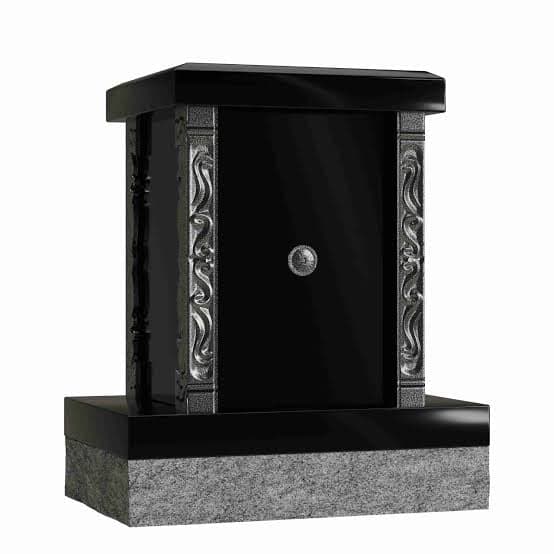
Cremation is now how most families say goodbye. The personal columbarium is a compact above-ground niche your family owns at your own cemetery plot: protected, visible, and at rest in sacred ground. A place you can stand beside, see into, and visit for generations.
Cremation has passed 60 percent of dispositions nationally and keeps rising, and in our region most families now choose it. What most families are never offered is a dignified place of their own to put at the center of it.
The door is glass, not a sealed granite face. The urn from the service, the one you chose and the one you carried, stays where you can see it: present, protected, and never closed away behind stone.
Roughly half of cremation urns never make it past the mantle. A mantle is not a plan for the next generation. A personal columbarium gives your family one settled place to visit, this year and fifty years from now.
The Catholic Church has permitted cremation since 1963, and its 2016 instruction asks that ashes rest in a sacred place, not scattered and not kept at home. Parishes are expected to renew emphasis on this teaching. A personal columbarium in blessed ground honors it while keeping your loved one close.
This is not a niche choice anymore, and it is not a guess. Here is sixty years of national data, and where the industry itself says it is heading.
3.6%
of American deaths ended in cremation in 1960
61.9%
chose cremation in 2024, versus 33.2% casket burial
82.1%
projected by 2045, per the funeral industry itself
| Year | Cremation rate |
|---|---|
| 1960 | 3.6% |
| 1975 | 6% |
| 1995 | 19.6% |
| 2001 | 26.2% |
| 2010 | 40.4% |
| 2015 | 47.9% |
| 2020 | 56.1% |
| 2024 | 61.9% |
| 2035 | 74.7% (projected) |
| 2045 | 82.1% (projected) |
Here is the problem that curve created: America's cemeteries were built for caskets, and its living rooms were never meant to be resting places. Most families now stand at the end of a service holding an urn, with no third option between a niche wall the cemetery owns and a shelf at home. The personal columbarium is that third option.
Some losses change what a family can bear. For many parents, the hardest part of a burial is not the ceremony. It is the thought of leaving someone in the dark.
We built the personal columbarium with those families in mind. It has a glass door. It has light. Nothing is buried, and nothing is far away. It stands in sacred ground where you can walk right up to it, any day you need to.
There is an optional interior light, soft as a candle, that comes on in the evening.
Behind the glass, the urn sits in a soft, steady glow. Not a spotlight, a presence. Drive the cemetery road after dusk and you will find it without looking for the row number. Families tell us that is exactly the point: you pass by on an ordinary Tuesday night, and they are there.
You will see their light from the road.
The optional evening light, lit for you to see at the showroom
The body is marine-grade aluminum under a baked powder-coat finish. Aluminum does not rust. It cannot; there is no iron in it to oxidize red. Where steel flakes and granite chips, an aluminum shell weathers by forming its own protective oxide layer and then simply stops changing.
And the finish is renewable: powder coat can be refreshed decades from now without touching the structure beneath it. This is a memorial engineered to be cared for across generations, not replaced.
It also comes in any color a family chooses. Granite offers eight colors the earth happened to make. Powder coat offers all of them, and hers.
A granite community columbarium weighs around 1,200 pounds and arrives the way freight that heavy has to: equipment on the lawn, rigging over other families' graves, a placement measured in days. At about 200 pounds, the personal columbarium is carried in and set gently by two people in an afternoon: no crane over anyone's resting place, a smaller foundation, and if life ever moves your family across the state, it can be professionally re-sited. Light never means loose: it anchors to a poured concrete foundation and stays exactly where it belongs.
The biggest everyday risk to a memorial is not weather or time. It is the mower that keeps the cemetery beautiful.
Cemetery crews mow and string-trim around every monument, every week, all season long, because they have to. Over years, the bottom three or four inches of any stone or structure collect small strikes: white nicks on polished granite, chips on sharp edges. It happens to every memorial in every lawn cemetery, and almost nobody selling memorials tells families about it.
We design for it instead. The personal columbarium sits on a base finished with an unpolished, rough-textured lower band - the same practice we use on our headstones. The trimmer still passes every week. The marks simply have nowhere to show. That is what honest engineering looks like at ground level.
A memorial should not need excuses in February. Here is what the personal columbarium is made of, and why.
In an 18-month field test here in Northeast Ohio, the interior stayed completely dry with no insect intrusion, through freeze, thaw, and lake-effect snow. We tested it in the weather it will live in before we offered it to a single family.
Powder-coated aluminum construction in any color your family chooses, at about 200 pounds, versus roughly 1,200 pounds for a granite community columbarium. It is placed with care, then anchored to a poured concrete foundation so it stays exactly where it belongs.
The clear door is impact-resistant polycarbonate, in the same material family used for fighter-jet canopies. It shrugs off a hammer. Ask to see the demonstration when you visit the showroom.
Cemetery mowers nick every monument eventually. Most sellers never mention it. We finish the base with an unpolished band so those small scars never show. It is the kind of detail families never think to ask about.
There is no single right answer. This is the plain version of the choice, the way we would explain it across a kitchen table.
| Option | The place | The cost | What to weigh |
|---|---|---|---|
| Private mausoleum | A private building on a large plot | Often tens of thousands of dollars, with months of construction | A beautiful option for the families who can choose it |
| Community columbarium niche | One niche in a shared wall, placed where the cemetery decides | Moderate, set by the cemetery | A shared structure with cemetery-owned placement and cemetery rules |
| Personal columbarium New | Your own plot, your own design, above ground in sacred ground | Typically a fraction of a private mausoleum; exact pricing in your written quote | Yours to design, yours to visit, yours to pass down |
| Urn at home | A mantle or a closet shelf | Little or nothing today | No permanence, no consecrated ground; the next generation inherits the decision |
Pricing is typically a fraction of a private mausoleum and is always confirmed in your written quote before anything is built.
| Construction | Powder-coated aluminum with sealed construction, offered in any powder-coat color your family chooses |
|---|---|
| Weight | About 200 pounds, versus roughly 1,200 pounds for a granite community columbarium |
| Door | Impact-resistant clear polycarbonate, the same material family used for fighter-jet canopies, with a lock |
| Capacity | A single urn, or companion urns resting side by side |
| Lighting | Optional soft interior light that glows in the evening |
| Base | Unpolished lower band that hides the small nicks cemetery mowers leave on every monument |
| Foundation and installation | Poured concrete foundation and professional installation by Reserve, with final finishing on site |
| Cemetery approval | Handled by Reserve: we prepare the paperwork and work with your cemetery directly |
National online headstone retailers sell a stone: freight-shipped to a curb, with the foundation, the installation, the cemetery paperwork, and any damage dispute left to you. Reserve sells a finished memorial, to the same standard as our 26-step finishing and installation process.
Visit the Hudson showroom and see the personal columbarium in person, with rocking chairs, coffee, and no pressure. Or begin by phone or video if that is easier.
Choose the color, lighting, and inscription with a designer. You approve a design proof before anything is built, so there are no surprises.
We prepare and submit the cemetery approval paperwork for your plot, then pour a proper concrete foundation, the step online sellers leave to you.
Once your cemetery approves, installation typically completes within days, not the weeks to months families experience elsewhere. It is the fastest installation timeline we know of in Northeast Ohio. And afterward, a person still answers the phone.
The personal columbarium is on display in our Hudson showroom, half monument samples and half sitting room. Sit in a rocking chair, look at it as long as you like, and ask anything. There is never any pressure here.