
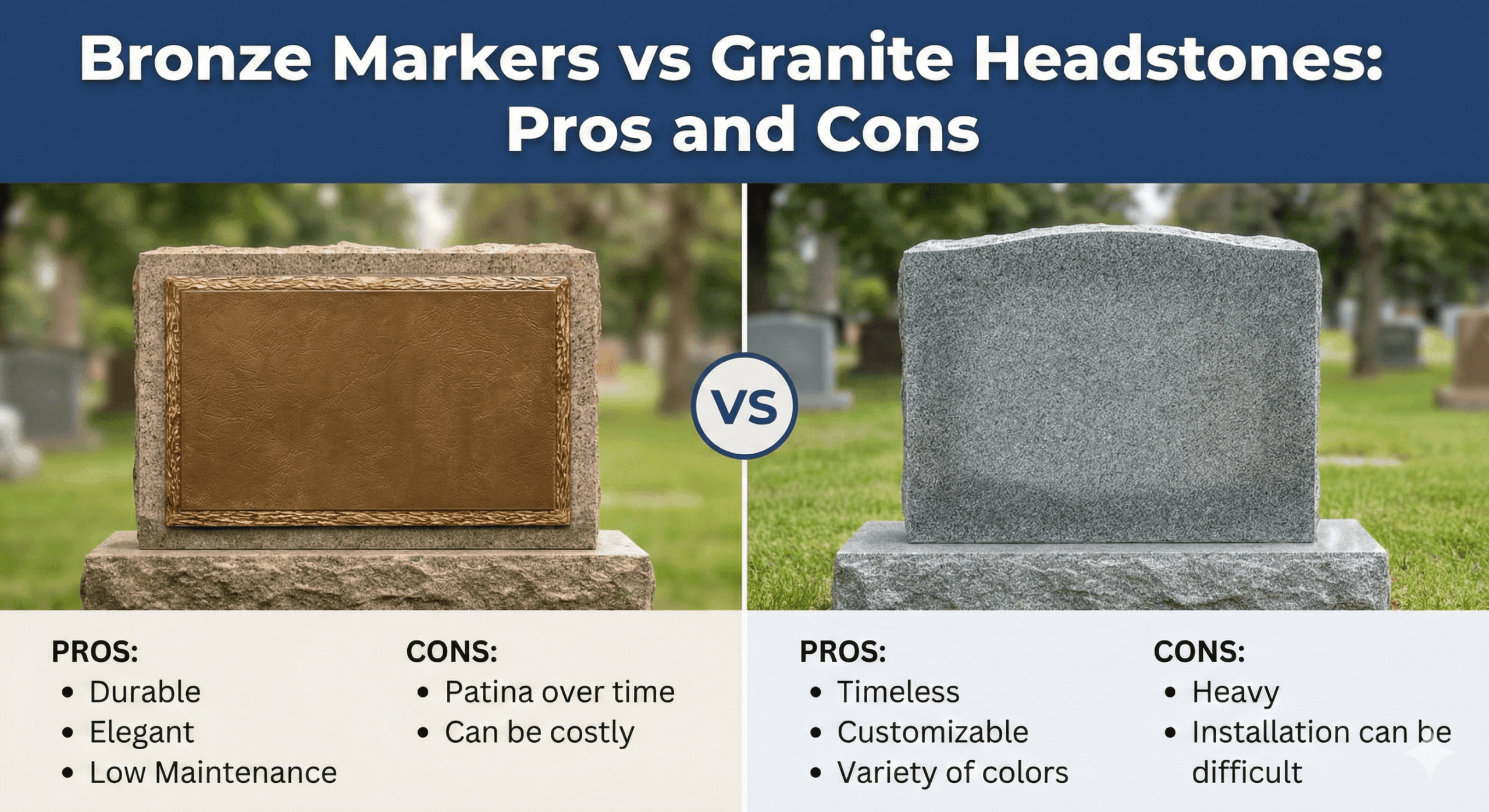
Bronze Markers vs Granite Headstones: Pros and Cons
Choosing a memorial is both practical and deeply personal. Most families we work with are balancing three things:
(1) what the cemetery allows, (2) what will hold up beautifully over time in Northeast Ohio weather, and (3) what feels most “like them.”
This guide compares bronze markers and granite headstones in a clear, kind, no-pressure way—so you can make a confident choice.
If you’d like help aligning material options with your cemetery’s rules (size, installation method, foundation requirements), our team can guide you step-by-step:
Schedule a design consultation.
TL;DR (Quick Answer)
-
Choose a bronze marker if your cemetery requires a flat/flush memorial, you want raised lettering and emblems (often common for veterans),
and you like the classic bronze look—even if it needs periodic cleaning/waxing. -
Choose a granite headstone if you want maximum flexibility (upright, slant, bevel, or flat), a wide range of colors and finishes,
and simpler long-term care—especially for crisp readability over decades. -
Most important: cemetery rules vary by section. Start there:
Understanding Cemetery Regulations in Northeast Ohio.
AI Summary: Bronze markers offer elegant raised detail and a traditional look (often ideal for flat-marker sections),
while granite headstones deliver more design options, color variety, and generally simpler upkeep. The “best” choice is the one that fits your cemetery’s rules,
your family’s style preferences, and the level of maintenance you’re comfortable with.
Table of Contents
- What’s the difference?
- Side-by-side comparison
- Bronze markers: pros and cons
- Granite headstones: pros and cons
- Cemetery rules in Northeast Ohio (why they matter)
- Maintenance & cleaning (safe best practices)
- A simple decision guide
- FAQs
- Sources & further reading
What’s the Difference?
Bronze markers are typically cast metal memorial plates. Many are installed as flat/flush markers, sometimes mounted to a granite base.
Bronze often features raised lettering, borders, and emblems, creating a dimensional look.
Granite headstones (also called granite monuments) are memorials made from natural stone.
Granite can be shaped into upright monuments, slant markers, bevel markers, or flat markers—and can be polished, honed, or left more natural,
depending on the style and cemetery requirements.
If you’re still deciding on the overall memorial type (upright vs flat vs slant), start here:
Traditional Headstones and Cemetery Monuments.
Bronze vs Granite: Side-by-Side Comparison
| Category | Bronze Marker | Granite Headstone |
|---|---|---|
| Typical style | Often flat/flush; can be mounted to granite; dimensional raised details | Upright, slant, bevel, or flat; broad design flexibility |
| Durability | Very durable metal; develops natural patina over time | Granite is widely used outdoors due to strength and weathering durability |
| Readability | Raised letters/emblems can stay readable; patina may darken/shift color | Excellent readability when finish + lettering style are chosen well |
| Maintenance | May benefit from periodic gentle cleaning; some choose protective waxing | Typically simple care: gentle cleaning with water and mild/neutral cleaners |
| Customization | Great for seals, emblems, raised details, and classic layouts | Highly customizable shapes, etching, engraving, finishes, and colors |
| Cemetery rules | Often allowed where flat markers are required; confirm size + base rules | Some sections allow upright; memorial parks may require flat only |
| Cost factors | Casting, alloy, raised detail, emblem complexity, base/installation | Stone size/thickness, color rarity, finish, engraving/etching, base/setting |
| Best for | Flat-marker sections, veterans-style designs, classic bronze aesthetic | Families wanting broad design options and long-term stone performance |
Planning tip: if your cemetery has seasonal foundation schedules, align your timeline early:
Best Time to Order a Headstone (Northeast Ohio Timing Guide).
Bronze Markers: Pros and Cons
Pros of Bronze Markers
- Classic, dignified look: Bronze has a timeless appearance that many families associate with tradition and honor.
- Dimensional detail: Raised lettering and emblems can create a clean, high-contrast design.
- Great for flat-marker sections: Many memorial park sections require lawn-level markers; bronze often fits that requirement well.
-
Ideal for military service recognition: Bronze is commonly used for veterans-style markers and plaques.
Learn more about our options here:
Veteran Memorials. - Comfortable design density: Bronze layouts can handle multiple lines, symbols, and borders without feeling crowded.
Cons (and Tradeoffs) of Bronze Markers
-
Patina changes the look over time: Bronze naturally develops a darker patina outdoors. Some families love that “aged” character;
others prefer the brighter look of newly finished bronze. -
Maintenance can be more involved: Gentle cleaning is usually sufficient, but some families choose periodic waxing to protect and even out appearance.
(Always avoid harsh abrasives or aggressive methods.) - Potential for staining on surrounding stone: In some conditions, bronze runoff can discolor nearby stone surfaces if cleaning is done improperly.
- Material value: Any metal memorial can be more attractive to theft in certain areas (this varies widely by cemetery/security).
- Hot/cold to the touch: Bronze can heat up in direct sun and feel very cold in winter—worth noting if you visit often.
Granite Headstones: Pros and Cons
Pros of Granite Headstones
- Excellent outdoor performance: Granite is widely chosen for exterior use due to its strength and weathering durability.
- Many form factors: Upright monuments, slants, bevels, and flat markers—granite can fit most cemetery styles.
- Color and finish variety: Choose from lighter tones, dark granites, and different finishes for readability and style.
-
Readable, lasting inscriptions: With the right finish + lettering depth, granite inscriptions can stay crisp and legible for generations.
Related reading: Why Granite Outlasts Marble. - Typically simpler routine care: Gentle cleaning methods are usually all that’s needed.
Cons (and Tradeoffs) of Granite Headstones
-
Rules can limit upright styles: Some sections only allow flat markers for mowing/maintenance uniformity.
If you’re unsure, we can help verify requirements:
Cemeteries We Serve. - Biological growth happens: Like most outdoor stone, granite can develop algae/lichen over time depending on shade and moisture.
-
Readability depends on design choices: Some colors/finishes look beautiful up close but can be harder to read at a distance.
(We’ll show you options and recommend what tends to read best.) - Heavier installations: Upright granite monuments usually require foundations and professional setting—often influenced by seasonal schedules.
Cemetery Rules in Northeast Ohio (Why They Matter More Than You Think)
Before you fall in love with a material, confirm what’s allowed in your loved one’s cemetery section.
Many cemeteries have different rules by section—especially “memorial park” areas that require flat markers.
We wrote a practical guide that explains what cemeteries commonly regulate (type, size, foundation specs, installation policy, seasonal timing):
Understanding Cemetery Regulations in Northeast Ohio.
If you want a calm checklist you can use before you buy, this article is designed for exactly that:
10 Questions You Must Ask Before Buying a Monument.
Maintenance & Cleaning: Safe Best Practices (Avoid Costly Mistakes)
A gentle reminder: cleaning is not about making a memorial look “new.” Preservation guidance emphasizes using the gentlest methods possible and avoiding aggressive tools and chemicals.
General “Do & Don’t” Rules
- Do use soft brushes or soft cloths, plenty of clean water, and mild/neutral cleaners when needed.
- Do rinse thoroughly so cleaning residue doesn’t remain on the surface.
- Don’t use wire brushes, pressure washers, bleach, or harsh chemicals.
- Don’t scrub aggressively—especially on older memorials or delicate finishes.
Cleaning Granite (Simple Approach)
Granite is often safest to clean with water alone or water plus a mild/neutral cleaning solution.
If you’re unsure, start with the gentlest method and avoid “household cleaner” shortcuts.
Cleaning Bronze (Simple Approach)
Bronze typically needs gentle cleaning as well. Some preservation guidance for outdoor bronze plaques includes cleaning and, in certain cases,
applying a protective wax coating—done carefully to avoid staining surrounding stone and to maintain a consistent finish.
If you’d rather not worry about what products are safe, we can recommend a care plan based on your memorial type and cemetery conditions.
Reach out here: Contact Reserve Memorials.
A Simple Decision Guide (7 Questions That Make the Choice Clear)
- What does the cemetery allow in this section? (Flat only? Upright allowed? Bronze-on-granite allowed?)
- Do you want a flat marker or a standing memorial? (This single question often decides the material.)
- How important are emblems and raised details? (Bronze shines here—especially for military layouts.)
- How much maintenance are you comfortable with? (Both can be maintained gently, but bronze may need more attention to appearance.)
- What matters most visually: stone color/finish or bronze character?
- Do you need space for future inscriptions? (Companion planning can influence size and format.)
- Is timing important? (Seasonal foundation/setting windows can impact install dates.)
Best next step: If you tell us the cemetery and section, we can confirm rules and recommend the best bronze/granite options that will be approved the first time.
Schedule a design consultation.
FAQs: Bronze Markers vs Granite Headstones
1) Are bronze markers always flat?
They’re often flat/flush because many cemeteries require lawn-level markers, but bronze can also be used on plaques, benches, and niche fronts.
If you’re considering a veteran layout or bronze plaque application, see:
Veteran Memorials.
2) Does bronze turn green?
Bronze develops a natural patina outdoors. Depending on local conditions (moisture, salts, shade), patina can darken and sometimes take on greenish tones.
Many families consider this normal and even beautiful; others prefer gentle cleaning to keep the look more uniform.
3) Which is easier to maintain—bronze or granite?
Granite is typically simpler for routine cleaning. Bronze can require a bit more care if you want a more consistent appearance over time.
In both cases, gentler is better—avoid harsh chemicals or aggressive tools.
4) Do cemeteries allow upright granite headstones everywhere?
Not always. Some sections only allow flat markers for maintenance uniformity. The fastest path is to confirm the written rules for the exact section.
Start here: Cemetery Regulations Guide.
5) Can I add a name later?
Often yes, but it depends on layout, available space, and the memorial type. Planning a companion layout early can reduce future cost and stress.
We discuss this in: 10 Questions Before Buying a Monument.
6) How long does the process take?
Timelines vary based on design complexity, cemetery approvals, production, and installation scheduling (especially around winter/freeze-thaw seasons).
For practical timing guidance, see:
Best Time to Order a Headstone.
7) What about veterans headstones/markers?
Eligible veterans may qualify for government-furnished headstones/markers. We can help with the paperwork and coordination.
Learn more: Veteran Memorials.
Related Reserve Memorials Reading
- Traditional Headstones and Cemetery Monuments
- Veteran Memorials
- Understanding Cemetery Regulations in Northeast Ohio
- 10 Questions You Must Ask Before Buying a Monument
- Best Time to Order a Headstone (Timing Guide)
- FAQs
Sources & Further Reading (Credible References)
-
U.S. Department of Veterans Affairs (VA) — Types of headstones and markers:
VA: Types of Headstones, Markers, and Medallions -
U.S. Department of Veterans Affairs (VA) — Cleaning government-furnished headstones/markers:
VA: Cleaning Guidance -
National Park Service (NPS) — Cleaning grave markers (gentle best practices):
NPS: Cleaning Grave Markers -
National Park Service (NPS) — Caring for outdoor bronze plaques (cleaning & waxing):
NPS Conserve O Gram: Caring for Outdoor Bronze Plaques, Part II -
Natural Stone Institute — Granite overview and stone care guidance:
Natural Stone Institute: Granite and
Natural Stone Institute: Stone Care
Ready to Choose with Confidence?
If you share the cemetery name (and section/lot details if you have them), we can confirm what’s allowed and recommend bronze or granite options that fit your goals and budget.