
The Short Version
- Cremation now accounts for roughly 63% of American dispositions, while burial has fallen to about 32%, according to the National Funeral Directors Association. Ohio sits close behind the national pace.
- The national median for a funeral with viewing and burial is about $8,300; with cremation it is about $6,280. Neither figure includes cemetery property, the grave opening, or a permanent marker.
- The cremation vs burial choice is not the end of the decision. Families still choose between a columbarium niche, an urn burial with a headstone, a memorial bench, scattering, or keeping ashes at home.
- Burial offers a fixed place to visit from day one. Cremation offers flexibility and time, though families who delay a permanent memorial often regret having nowhere to go.
- Veterans are eligible for a no-cost government marker whether they are buried or cremated, including niche markers for columbariums.
Cremation vs Burial: The Question Behind the Question
Most families who ask about cremation vs burial are really asking something quieter: where will we go to remember them? The mechanics of cremation vs burial matter, and so does the cost. But the part that shapes the next twenty years is the memorial, and that decision belongs to the family long after the funeral director has said goodbye.
The numbers have shifted dramatically in one generation. In 2025 the cremation rate in the United States reached roughly 63.4%, against a burial rate near 31.6%, and the National Funeral Directors Association projects cremation will climb past 70% by 2030. Ohio has followed the same curve at a slightly slower pace, landing in the 50% to 60% range across most counties in Northeast Ohio. Cremation is no longer the alternative choice. It is the common one.
That shift creates a gap our team in Hudson sees almost weekly. Families choose cremation for practical reasons, then discover months later that there is no place to bring flowers, no name carved anywhere, no spot for grandchildren to stand. This guide walks through cremation vs burial honestly: what each actually costs, what each involves, and what memorial options follow from either choice. If you are early in the process and still comparing prices, our 2026 headstone cost guide and cemetery plot cost guide pair well with what follows.
Cremation vs Burial: What You Are Actually Comparing
Cremation vs burial is often presented as two products on a menu. In practice each one is a sequence of separate decisions, and the totals diverge based on choices made well after the disposition itself.
Traditional burial, step by step
A conventional burial involves preparation of the body, a casket, a funeral or graveside service, a cemetery plot, an outer burial container or vault required by most Ohio cemeteries, the opening and closing of the grave, a concrete foundation, and finally a headstone or grave marker. Each of those is billed separately, often by three different businesses: the funeral home, the cemetery, and the memorial company.
Cremation, step by step
Cremation involves transport, a cremation container, the cremation itself, permits and the death certificate, an urn, and then whatever memorial the family chooses. Direct cremation, with no viewing or service beforehand, is the least expensive disposition available in Ohio. Cremation with a full service and viewing costs considerably more and can approach the price of a burial once a rental casket and facility fees are added.
A useful way to frame it: cremation is a method of preparing remains, not a memorial plan. Burial bundles the two together by default. With cremation, the memorial is a separate decision your family gets to make on its own timeline, which is both the advantage and the risk.
Cremation vs Burial Cost: What the Numbers Really Say
The National Funeral Directors Association puts the national median for a funeral with viewing and burial at roughly $8,300, and a funeral with cremation at roughly $6,280. Those medians are widely quoted and widely misunderstood, because both exclude the cemetery entirely. No plot, no grave opening, no vault, no marker.
National median gap between a funeral with burial and a funeral with cremation, before any cemetery or memorial costs
Here is a fuller picture of the line items families in Northeast Ohio typically encounter. Ranges reflect what we see across the Hudson, Stow, Akron, and Cleveland markets, and vary considerably by cemetery.
| Cost element | Traditional burial | Cremation |
|---|---|---|
| Funeral home services | $5,500 to $9,000 | $1,200 to $5,000 |
| Casket or urn | $2,000 to $10,000 | $75 to $1,500 |
| Cemetery property | $1,500 to $5,000 (full plot) | $500 to $3,500 (urn plot or niche) |
| Opening and closing | $1,000 to $2,500 | $350 to $900 |
| Vault or grave liner | $1,000 to $3,000 | $0 to $400 (urn vault) |
| Permanent memorial | $1,200 to $8,000+ | $300 to $6,000+ |
| Typical all-in range | $12,000 to $25,000 | $2,500 to $14,000 |
The spread on the cremation side is wide for a reason. A direct cremation with a simple scattering can be completed for under $3,000. A cremation with a full viewing, a granite columbarium niche, and a bronze niche plaque can land close to what a burial would have cost. The savings come from the choices, not from the cremation itself.
Where families are surprised
Three costs catch people off guard. First, the outer burial container: most Ohio cemeteries require a vault or liner to keep the ground from settling, and it is a cemetery rule rather than a state law. Second, the foundation: a headstone cannot simply be placed on the ground, and the concrete foundation poured beneath an upright monument is a separate charge. Third, the second interment fee on a companion plot, which comes due years later when the surviving spouse passes. Our guide to cemetery regulations in Northeast Ohio covers how these rules vary from one cemetery to the next.

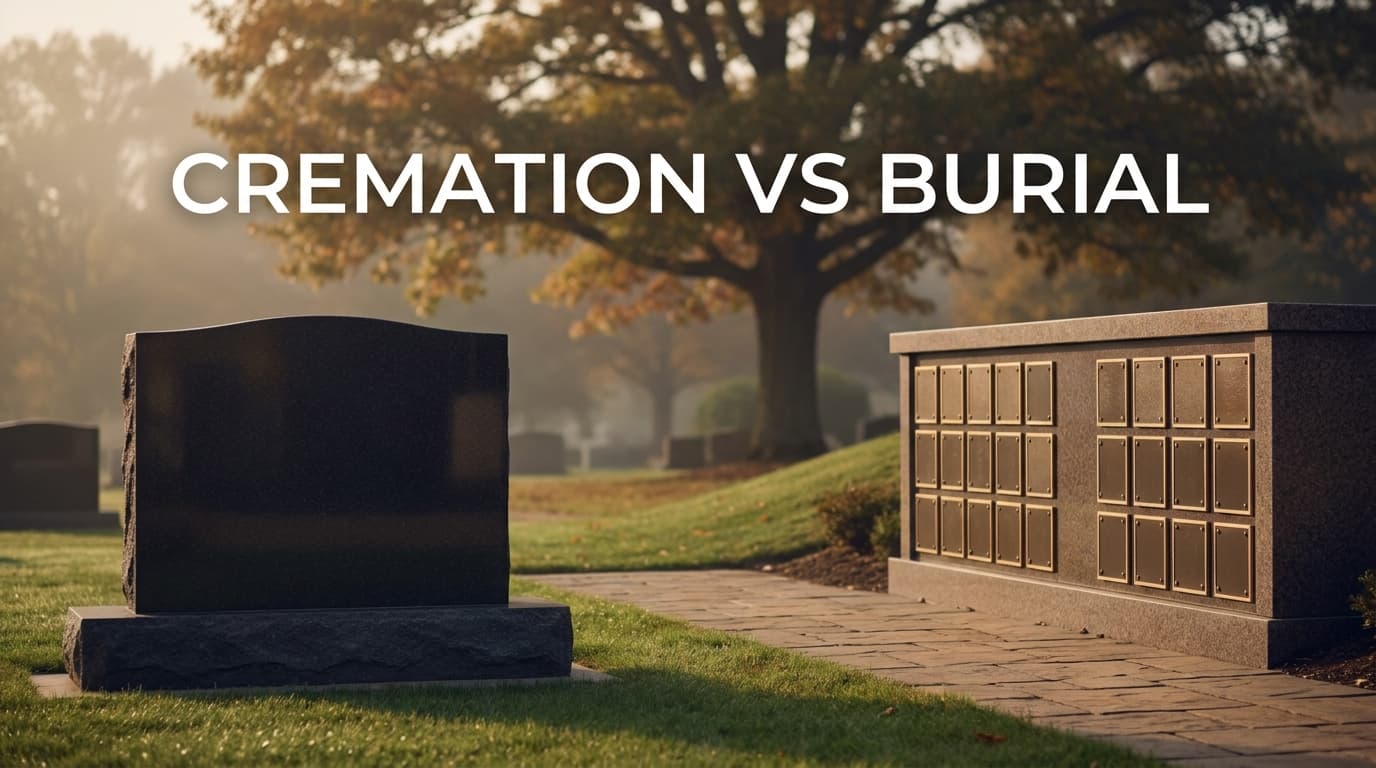
Cremation vs burial at a glance: costs, timelines, and the memorial options that follow each choice.
Memorial Choices That Follow Cremation vs Burial
This is the part of the comparison that gets the least attention and matters the most. Whatever the disposition, a family will eventually want a place with a name on it.
If you choose burial
The memorial question is straightforward and the cemetery usually decides the format for you. Some sections permit only flat grave markers set level with the turf, which simplifies mowing. Other sections allow upright headstones with a base and die, which give far more room for design and inscription. Most families in our area choose granite for its durability through Ohio freeze-thaw cycles, though bronze markers remain standard in memorial-park cemeteries.
Married couples frequently choose a companion headstone that carries both names from the start, with the second date added later. It is almost always less expensive than commissioning two separate memorials, and it lets the surviving spouse participate in the design.
If you choose cremation
On the cremation vs burial spectrum, cremation opens more doors than most families realize. The options we help Ohio families weigh most often:
- Columbarium niche. A sealed compartment in a granite or bronze structure, typically fronted with an engraved plate. Our complete columbarium guide walks through sizes, costs, and how niches are inscribed. Many Northeast Ohio churches and cemeteries have added columbariums in the last decade.
- Urn burial with a headstone. Ashes are interred in a standard or cremation-sized plot and marked with a full headstone. This is the option families choose when they want cremation’s simplicity and burial’s sense of place. Plot costs are lower and many cemeteries permit two or even four urns in a single grave.
- Memorial bench. A granite memorial bench can serve as both a marker and a place to sit. Some designs include a sealed cremation chamber in the base.
- Scattering with a marker elsewhere. Families who scatter often later commission a small plaque, boulder, or bench at a cemetery or garden so there is still a named place to visit.
- Keeping ashes at home. Common, and entirely legal in Ohio, though worth thinking a generation ahead. Ask who will be responsible for the urn in thirty years. Our cremation urn guide covers materials and sizing.
- Above-ground entombment. A mausoleum crypt or cremation niche for families who prefer not to be interred in the ground.
A pattern worth naming: families who choose cremation and defer the memorial decision often let three, five, even ten years pass. Grief has no deadline, and there is nothing wrong with waiting on the memorial. But the families who tell us they wish they had acted sooner outnumber the ones who wish they had waited.
Veterans: The Benefit Applies Either Way
If your loved one served, the Department of Veterans Affairs will furnish a headstone, flat marker, or niche marker at no cost, and that benefit is not affected by the choice between cremation and burial. Cremated remains interred in a private cemetery are eligible, and so are niche markers for a columbarium. Burial in a VA national cemetery, including Ohio Western Reserve National Cemetery in Rittman, comes with the plot, the opening and closing, a government marker, and perpetual care at no charge to the family.
The application is VA Form 40-1330, and it is one of the more commonly missed benefits we encounter. Our full VA headstone guide covers eligibility, inscription rules, and how to apply. Reserve Memorials sets government markers throughout Northeast Ohio and can handle the paperwork alongside the installation.
Faith, Family, and the Considerations That Are Not Financial
Cost tends to dominate the cremation vs burial conversation, but it is rarely the deciding factor once families sit down together.
Religious guidance. The Catholic Church permits cremation and asks that cremated remains be interred in a cemetery or columbarium rather than scattered or kept at home. Most Protestant denominations leave the choice to the family. Orthodox Judaism and Islam call for burial. Hinduism and Buddhism traditionally favor cremation. If faith matters to your family, a conversation with your clergy early on prevents difficult revisions later.
Environmental considerations. Both options carry a footprint. Cremation uses natural gas and releases carbon; conventional burial uses embalming chemicals, hardwood or metal caskets, and concrete vaults. Families weighing this often look at green burial, which skips the vault and embalming entirely and is available at a growing number of Ohio cemeteries.
Family consensus. The single most common source of conflict we see is a decision made quickly by one family member that others were not part of. If siblings disagree, urn burial with a headstone is often the compromise that satisfies everyone: it honors a preference for cremation while giving the family the fixed, visitable place that burial provides.
Timing. Burial runs on a schedule set by the funeral. Cremation gives you weeks or months to plan a memorial service, gather relatives from out of state, and choose a marker without pressure. For families spread across the country, that flexibility is often worth more than the cost difference.
How to Work Through the Cremation vs Burial Decision
If you are weighing cremation vs burial now, or thinking ahead for yourself, here is the sequence we suggest to families who come through our door in Hudson.
- Ask whether they left instructions. Check the will, any prepaid funeral contract, and the Ohio declaration of final disposition if one exists. A written wish settles the question and spares the family from second-guessing.
- Decide on the memorial before you decide on the disposition. Reversing the usual order clarifies everything. If the family knows it wants a headstone at a specific cemetery, cremation with urn burial and traditional burial both get you there, at very different prices.
- Call the cemetery, not just the funeral home. Cemetery rules determine what memorial you can install: upright versus flat, maximum dimensions, foundation requirements, and vase policies. Ask before you buy anything. We serve more than 4,100 cemeteries across Ohio and can confirm the regulations at yours.
- Get an itemized price list. The FTC Funeral Rule entitles you to a written general price list from any funeral home, and you may decline any item you do not want. Compare two or three providers.
- Budget the memorial separately. Set aside funds for the marker and its foundation from the start. It is the piece that lasts longest and the one most often postponed. Our headstone design guide and inscription ideas are good places to begin imagining it.
- Take your time with the design. Whatever path you choose, the memorial is the part that carries their name forward. There is no rush on the lettering, the shape, or the imagery.
There is no wrong answer in cremation vs burial. Both are ways of saying that a life mattered. What matters more is that the people who loved them have somewhere to go.
How Reserve Memorials Helps, Whichever You Choose
We are a family-owned memorial company at 30 Ravenna Street in Hudson, and we work with families on both sides of the cremation vs burial decision every week. For burials we design and set headstones and monuments, pour the foundations, and handle the cemetery approvals. For cremation we design columbarium niches and niche plates, urn-burial markers, and memorial benches. We serve more than 4,100 cemeteries across Ohio, from Hudson and Stow to Akron, Cleveland, Canton, and beyond.
If you are still deciding, that is exactly the right moment to talk with us. Knowing what memorial you want often makes the disposition question answer itself. There is no cost for the conversation and no obligation.
Frequently Asked Questions
Is cremation always cheaper than burial?
Usually, but not automatically. A direct cremation is the least expensive option available and can cost under $3,000 in Ohio. A cremation with a viewing, a rental casket, a granite columbarium niche, and an engraved bronze plate can approach the cost of a traditional burial. The savings come from the choices you make around the cremation, not from the cremation itself.
Can you still have a headstone if you choose cremation?
Yes, and many Ohio families do. Cremated remains can be buried in a standard or cremation-sized plot and marked with a full upright or flat headstone, exactly as a casket burial would be. Many cemeteries permit two or more urns in a single grave, which keeps both the plot cost and the memorial cost lower for a couple.
Is it legal to keep ashes at home in Ohio?
Yes. Ohio places no restriction on keeping cremated remains at home, and scattering on private property with the owner’s permission is permitted. The practical question is what happens a generation from now. Many families keep the urn for a period and later inter a portion in a cemetery or columbarium so there is a permanent, named place for future generations.
Do veterans still receive a free marker if they are cremated?
Yes. The VA furnishes a headstone, flat marker, or niche marker at no cost for eligible veterans regardless of whether the remains are buried or cremated, including niche markers designed for columbariums. The application is VA Form 40-1330. Reserve Memorials handles this paperwork and sets government markers throughout Northeast Ohio.
How long can we wait before choosing a memorial?
There is no deadline, and some cemeteries have no time limit at all. Practically, granite memorials take roughly eight to sixteen weeks from approved design to installation, and Ohio winters pause foundation work from late November through March. Many families order in the first year, but taking longer is common and perfectly acceptable. What matters is that the decision eventually gets made rather than deferred indefinitely.